
Google AI Overviews are changing how information appears in search results, influencing website visibility, organic click-through rates, and how users discover sources. As Google’s AI-generated summaries expand across more searches, businesses and publishers are examining whether these summaries reduce website traffic or create new opportunities for visibility.
At QuoteFlow Marketing, we recognize the importance of understanding these changes as businesses adapt their digital marketing strategies to an evolving search landscape. However, the reported impact varies considerably across studies, which use different keyword databases, geographic markets, devices, and measurement periods.
The following Google AI Overviews statistics examine their prevalence, user behavior, industry coverage, organic search performance, citations, and reported impact on publishers and businesses.
Google AI Overviews Statistics – 10 Key Takeaways
The following key takeaways summarize the main findings from the available research on Google AI Overviews statistics and their impact on search behavior, visibility, and website traffic.
- BrightEdge found AI Overviews appeared for 48% of queries in February 2026.
- Google reported more than 2 billion monthly users of AI Overviews worldwide.
- Seer Interactive found organic CTR fell from 1.76% in June 2024 to 0.61% in September 2025, then rose to 2.4% in February 2026.
- Pew Research found traditional results received clicks in 8% of visits with AI summaries, versus 15% without them.
- Pew Research found links within AI summaries received clicks in just 1% of visits.
- Ahrefs reported a 58% average CTR reduction for top-ranking pages in its December 2025 analysis.
- BrightEdge found AI Overview coverage reached 88% in healthcare, 83% in education, and 82% in B2B technology.
- Studies found 17%–38% of cited pages also ranked in Google’s organic top 10.
- Global Google Search referral traffic to publishers fell approximately 33% year over year through November 2025.
- Seer Interactive found brands cited in AI Overviews received 120% more organic clicks per impression than uncited brands.
Overall, the findings suggest that AI Overviews are reshaping search visibility and click behavior, although the scale of their impact varies across studies, industries, and websites.
What Are Google AI Overviews and How Common Are They?
Google AI Overviews are AI-generated summaries that appear in some Google Search results, providing concise answers by synthesizing information from multiple sources. They often include links to relevant webpages, allowing users to explore the information in greater detail.
Their presence varies depending on the search query, user intent, and industry. While some searches display AI-generated summaries prominently, others continue to show traditional organic results without an AI Overview. Understanding how frequently these summaries appear helps explain their growing role in search visibility, user behavior, and website traffic.
AI Overview prevalence varies across studies
Google AI Overviews have expanded considerably since early 2025, but researchers have reported different estimates of how frequently they appear. Semrush’s analysis of more than 10 million keywords found the following progression:
- January 2025: 6.49% of tracked queries.
- February 2025: 7.64%.
- March 2025: 13.14%.
- July 2025: Approximately 25%, the reported peak.
- November 2025: 15.69%.
Other studies produced higher estimates in 2026. BrightEdge reported 48% in February 2026 and a 58% year-over-year increase. Xponent21 reported a U.S. prevalence estimate of 60.32% in April 2026.
Why do the reported percentages differ?
The figures do not necessarily contradict one another. Studies can differ in:
- The keywords and search categories included.
- Geographic markets and languages.
- Desktop versus mobile search coverage.
- The period in which results were collected.
- The methods used to detect AI Overviews.
Consequently, no single percentage should be presented as the universal share of Google searches that trigger AI Overviews.
How many people use AI Overviews?
Google has reported that AI Overviews reach more than 2 billion monthly users across over 200 countries and territories and more than 40 languages.
This figure measures reported monthly audience reach, not the percentage of queries displaying an AI Overview. The two metrics describe different aspects of adoption and should not be used interchangeably.
Which Searches and Industries Trigger AI Overviews?
Google AI Overviews do not appear equally across all searches. Their presence varies by search intent, query length, and industry, with some types of searches and sectors showing substantially higher coverage than others.
Informational queries remain important
AI Overview coverage varies according to search intent. Informational searches have historically represented a substantial share of queries triggering AI-generated summaries.
Semrush data cited in the supplied research showed that informational queries accounted for 91.3% of AI Overview-triggering searches in January 2025. By October 2025, that share had declined to 57.1%, while the shares associated with commercial, transactional, and navigational queries had increased.
This change suggests that AI Overviews were appearing across a broader mix of search intents in the tracked dataset. It does not mean that every query category experienced the same growth.
Long and question-based searches
Several studies reported higher AI Overview trigger rates for certain query formats.
| Query type or characteristic | Reported finding |
| Comparison queries, such as “X vs. Y” | 95.4% trigger rate |
| Review queries | 86.3% |
| Question queries | 85.9% |
| Queries containing eight or more words | 7 times more likely to trigger an AI Overview than shorter queries |
These findings suggest that detailed, question-oriented searches are important to AI Overview coverage. However, the reported rates should not be interpreted as guarantees for individual queries.
AI Overview coverage by industry
BrightEdge reported substantial differences across industries:
| Industry | Reported coverage |
| Healthcare | 88% |
| Education | 83% |
| B2B technology | 82% |
| Restaurants | 78% |
| Insurance | Approximately 63% |
| Entertainment | 37% |
Healthcare, education, and B2B technology had some of the highest reported coverage. These are study-specific estimates, not fixed rates for every search within each industry.
How Users Interact With AI Overviews
AI Overviews change how users consume search results by presenting summarized answers directly on the results page. Research examines whether people engage with these summaries, click cited sources, or continue to traditional organic listings.
AI summaries can reduce traditional-result clicks
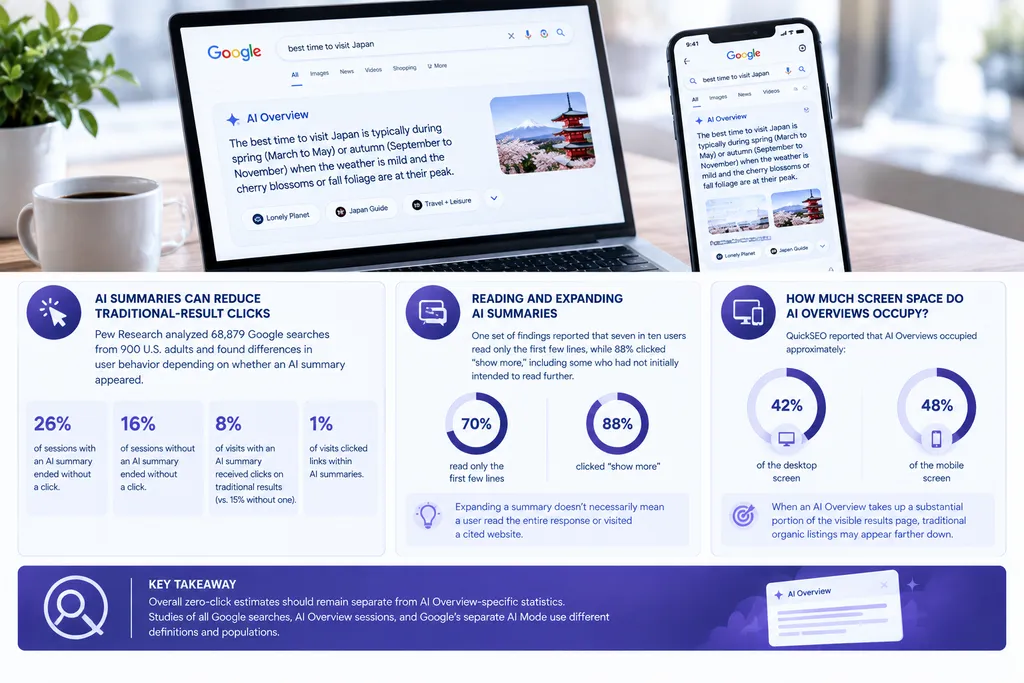
Pew Research analyzed 68,879 Google searches from 900 U.S. adults and found differences in user behavior depending on whether an AI summary appeared.
- 26% of sessions with an AI summary ended without a click.
- 16% of sessions without an AI summary ended without a click.
- Traditional search results received clicks in 8% of visits with an AI summary, compared with 15% without one.
- Links within AI summaries received clicks in only 1% of visits.
These results indicate that users may obtain enough information from the results page to avoid opening another website. However, they describe the sessions measured in Pew’s study rather than every Google search.
Reading and expanding AI summaries
Other supplied research examined how users interact with the summaries themselves. One set of findings reported that seven in ten users read only the first few lines, while 88% clicked “show more,” including some who had not initially intended to read further.
Such figures need to be interpreted according to the underlying study and its definition of interaction. Expanding a summary, for example, does not necessarily mean a user read the entire response or visited a cited website.
How much screen space do AI Overviews occupy?
QuickSEO reported that AI Overviews occupied approximately:
- 42% of the desktop screen in its analysis.
- 48% of the mobile screen in its analysis.
When an AI Overview takes up a substantial portion of the visible results page, traditional organic listings may appear farther down. This offers a potential explanation for why some websites experience lower CTR even when their rankings have not changed.
Overall zero-click estimates should remain separate from AI Overview-specific statistics. Studies of all Google searches, AI Overview sessions, and Google’s separate AI Mode use different definitions and populations.
How AI Overviews Affect Organic CTR and Search Traffic
Click-through rate (CTR) measures how often users click a result after it receives an impression. Several supplied studies reported lower organic CTR for searches displaying AI Overviews, although the magnitude of the change differed.
Organic CTR declined in several studies
Seer Interactive reported the following organic CTR figures for queries triggering AI Overviews:
| Period | Reported organic CTR |
| June 2024 | 1.76% |
| September 2025 | 0.61% |
| February 2026 | 2.4% |
The decline from 1.76% to 0.61% represents approximately 65% when calculated from the reported values. The subsequent increase to 2.4% indicates a substantial recovery in the same series of reported figures.
In its later analysis, Seer also reported that CTR for queries without AI Overviews increased from 2.8% to 3.8%. The results suggest that CTR trends can change over time rather than follow a single, uninterrupted downward trajectory.
How large were the reported declines?
Other studies found different levels of impact:
- Ahrefs: An average 58% CTR reduction for top-ranking pages in its analysis of approximately 863,000 keywords and 4 million AI Overview URLs.
- Amsive: An average CTR decline of 15.49% across approximately 700,000 keywords.
- Pew Research: Traditional-result clicks in 8% of visits with an AI summary, versus 15% without one.
- Seer Interactive: A reported decline in paid CTR from 19.7% to 6.34% for AI Overview searches in one 2025 dataset.
These figures should not be combined into a single average. They come from different datasets and do not all measure the same outcome. For example, click behavior recorded in a user panel is different from CTR calculated from search impressions and clicks.
What about paid search?
Paid search results have also shown mixed patterns. Seer’s later analysis reported a paid CTR of 14.6% – 16.2% during Q1 2026 for queries with AI Overviews, compared with 26% declining to 21.8% for queries without them.
The contrast between studies highlights the importance of the observation period, query mix, and methodology. A decline in CTR also does not automatically establish that AI Overviews caused every change in website traffic.
For individual businesses, Search Console and analytics data can help establish whether impressions, clicks, and traffic changed for their own pages and queries during the same period.
Which Websites Get Cited in AI Overviews?
AI Overview citations provide another way for websites to appear in search results. Some cited pages do not rank among Google’s top ten traditional organic results, suggesting that organic position alone does not explain every citation.
Which domains appear frequently?
The supplied studies identified YouTube, Wikipedia, Reddit, company websites, and established publishers among recurring sources. Surfer SEO’s analysis of 46 million citations reported the following shares:
- YouTube: 23.3%.
- Wikipedia: 18.4%.
Other research cited in the supplied materials reported a 21% citation share for Reddit. However, the reported shares vary across studies, partly because researchers analyze different periods, query categories, and types of AI-generated responses.
Some findings concern AI Overviews specifically, while others examine broader AI search or language-model answers. Their figures should not be treated as directly interchangeable.
Do AI Overview citations match organic rankings?
Research suggests that citation sources and traditional organic rankings overlap, but the extent of that overlap differs significantly.
Some early-2026 analyses placed the share of cited pages that also appeared in Google’s organic top ten at approximately 17%–38%. Other studies reported higher overlap, including estimates from earlier periods.
These differences make it difficult to identify one universal percentage. They also mean that citation data alone cannot establish that traditional organic rankings have become irrelevant.
Do cited brands receive more clicks?
Seer Interactive reported a notable difference between cited and uncited brands:
- Brands cited in AI Overviews received 120% more organic clicks per impression than uncited brands in its 2026 analysis.
- A separate 2025 finding reported 91% more paid clicks for cited brands.
These findings suggest that citations may be associated with additional visibility or clicks. They do not guarantee the same results for every website, and the reported associations should not be interpreted as proof that citations alone caused the differences.
The Impact of AI Overviews on Publishers and Businesses
The expansion of AI-generated summaries has coincided with declining Google Search referral traffic for some publishers. The scale of reported changes varies by business and measurement period.
Reported changes in publisher traffic
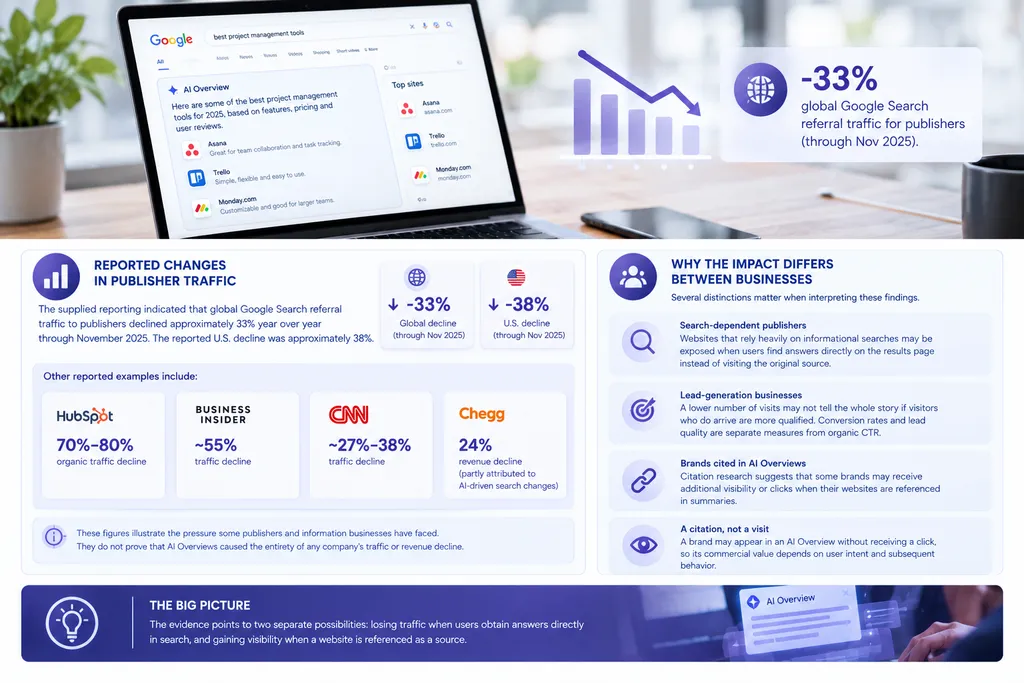
The supplied reporting indicated that global Google Search referral traffic to publishers declined approximately 33% year over year through November 2025. The reported U.S. decline was approximately 38%.
Google Discover referrals also fell by approximately 21% globally in the cited data. Other reported examples include:
- HubSpot: Organic traffic reportedly declined by 70%–80%.
- Business Insider: Reported traffic declined approximately 55%.
- CNN: Reported traffic declined approximately 27%–38%.
- Chegg: Reported a 24% year-over-year revenue decline and attributed part of its difficulties to AI-driven search changes.
These figures illustrate the pressure some publishers and information businesses have faced. They do not prove that AI Overviews caused the entirety of any company’s traffic or revenue decline.
Why the impact differs between businesses
Several distinctions matter when interpreting these findings.
- Search-dependent publishers: Websites that rely heavily on informational searches may be exposed when users find answers directly on the results page instead of visiting the original source.
- Lead-generation businesses: A lower number of visits may not tell the whole story if visitors who do arrive are more qualified. Conversion rates and lead quality are separate measures from organic CTR.
- Brands cited in AI Overviews: Citation research suggests that some brands may receive additional visibility or clicks when their websites are referenced in summaries.
A citation, however, is not the same as a website visit. A brand may appear in an AI Overview without receiving a click, so its commercial value depends on user intent and subsequent behavior.
The evidence therefore points to two separate possibilities: losing traffic when users obtain answers directly in search, and gaining visibility when a website is referenced as a source.
What Research Says About Trust, Source Recall, and Advertising
An experiment reported on October 12, 2026, examined how AI Overviews influenced users’ perceptions of search results. It involved 796 U.S. adults, with one group seeing results containing AI Overviews and another seeing results without them.
Users recalled fewer sources
The study reported differences in how well participants remembered the websites behind search information.
| Measure | Without AI Overview | With AI Overview |
| Could name at least one website | 76% | 56% |
| Average number of sources recalled | 1.65 | 1.10 |
| Remembered at least three sources | 25% | 13% |
The experiment found no statistically significant overall improvement in trust, usefulness, or satisfaction when AI Overviews were present.
This is an important distinction: a generated summary may provide a convenient answer while making the individual sources behind that answer less memorable.
Results differed by age group
Among Gen Z participants, reported trust rose from 49% without an AI Overview to 67% with one. Perceived usefulness increased from 56% to 70%, while source recall declined from 74% to 60%.
These findings should be interpreted cautiously. The study represents one experiment rather than a definitive measure of all Google users, and some age-group samples were small.
What about advertisements?
The same experiment found that 61% of participants correctly recognized an advertisement or sponsored listing when an AI Overview was present, compared with 41% in the control group.
This finding describes ad recognition in the experiment. It does not establish that AI Overviews caused changes in advertising placement or performance across Google’s entire search platform.
More broadly, the experiment highlights the difference between finding a summary useful and remembering the original sources. Because the study is limited to one experimental setting, its conclusions need further replication.
Conclusion
The latest Google AI Overviews statistics show a search environment in transition. Reported coverage has expanded significantly, although prevalence estimates vary by dataset. Several studies have found lower traditional-result click-through rates for searches displaying AI summaries, and publisher referral traffic has declined in some reported datasets. At the same time, citation research suggests that some brands may gain additional visibility or clicks when their websites appear as sources.
The evidence is not uniform. CTR estimates, citation patterns, and user behavior differ across studies, and changes occurring alongside AI Overview expansion cannot automatically be attributed to the feature alone.
For businesses and publishers, the most useful approach is to evaluate each statistic in context, distinguish visibility from actual website traffic, and monitor performance using their own data. No single percentage fully captures the impact of Google AI Overviews.
Sources used:
- https://www.omnibound.ai/blog/google-ai-overviews-statistics
- https://memeburn.com/google-ai-overview-statistics/
- https://www.forbes.com/advisor/business/ai/google-ai-overview-study-results/
- https://heroicrankings.com/seo/managed/google-ai-overview-statistics-2026/
- https://www.sellerscommerce.com/blog/ai-overview-statistics/
- https://thestacc.com/blog/google-ai-overview-statistics/
- https://presenc.ai/research/ai-overviews-usage-statistics
- https://quickseo.ai/blog/google-ai-overviews-statistics-2026-60-data-points-every-seo-should-know
- https://ahrefs.com/blog/ai-overviews-reduce-clicks-update/
- https://www.seerinteractive.com/insights/aio-impact-on-google-ctr-september-2025-update
- https://www.pewresearch.org/short-reads/2025/07/22/google-users-are-less-likely-to-click-on-links-when-an-ai-summary-appears-in-the-results/
- https://www.semrush.com/blog/ai-overviews/
- https://www.brightedge.com/resources/weekly-ai-search-insights/ai-overviews-one-year-presence-size-citing
- https://conductor.com/blog/ai-overviews-study/
- https://www.pewresearch.org/short-reads/2025/07/22/google-users-are-less-likely-to-click-on-links-when-an-ai-summary-appears-in-the-results/
- https://almcorp.com/blog/google-ai-overviews-surge-9-industries/