
Buying a vehicle or choosing an automotive service often involves more research than a single visit to a website. Customers compare models, explore service options, watch demonstrations, read reviews, and look for reliable information before deciding who to trust.
Automotive content marketing helps businesses reach these customers during that research process. By publishing useful articles, vehicle comparisons, service guides, videos, and project examples, dealerships and automotive service providers can answer common questions, showcase their expertise, and give potential customers more reasons to choose their business.
What Is Automotive Content Marketing?
Automotive content marketing is the use of valuable content to attract, inform, and engage potential customers in the automotive industry.
It includes blog articles, buying guides, vehicle comparisons, videos, customer project showcases, and social media posts. This content helps potential customers learn about vehicles, understand automotive services, compare their options, and find answers to common questions.
For automotive businesses, useful content can also increase brand awareness and attract potential customers who may be interested in their products or services. This makes content marketing a valuable part of broader automotive lead generation efforts.
Why Content Marketing Matters in the Automotive Industry
Automotive customers often research several options before making a purchase or booking a service. This creates opportunities for businesses to reach them before they are ready to make contact.
Content Influences Purchasing Decisions
Research from the 2025 Cox Automotive GfK Content Influence Study highlights the role content plays in vehicle purchasing decisions.
| Research finding | Percentage |
| New-car shoppers who use content during research | 92% |
| Shoppers who first discover their chosen vehicle through content | 42% |
| Shoppers who rely on video during research | Nearly 70% |
| Shoppers who take further action after watching automotive video | 75% |
The actions reported after watching automotive videos include researching additional information, visiting a dealership, and exploring financing. These findings demonstrate that content can influence multiple stages of the purchasing journey, from initial research to evaluating options and taking action.
This reflects a broader shift toward digital-first automotive marketing, where search, social media, video, and online research influence how customers discover and evaluate businesses. These trends are also reflected in our automotive marketing statistics.
Content Helps Businesses Demonstrate Expertise
Automotive services can involve technical processes that customers may not fully understand. Explaining these processes gives businesses an opportunity to demonstrate their knowledge.
For example, a detailing company can explain how paint correction works and how it removes certain surface imperfections, while an auto repair shop can describe how technicians investigate engine problems.
Specific explanations and real demonstrations provide stronger evidence of expertise than generic claims about service quality.
Content Supports Organic Search Visibility
Every useful article or guide creates another opportunity for a business website to appear in relevant search results. However, automotive businesses should not overlook local search visibility, particularly when customers are looking for nearby dealerships, repair shops, and service providers. Combining informative content with local SEO for automotive businesses helps companies reach customers researching services in specific geographic areas.
Types of Content Automotive Businesses Should Create
Different content formats serve different purposes. Some explain complex subjects, while others demonstrate products, showcase completed work, or help customers compare available options.
| Content type | Automotive examples | Primary purpose |
| Blog articles | Maintenance guides, shipping advice | Answer customer questions |
| Buying guides | Used-car inspections, vehicle comparisons | Support purchasing decisions |
| Videos | Vehicle walkarounds, detailing demonstrations | Show products and processes |
| Case studies | Completed detailing and repair projects | Demonstrate actual work |
| Comparison pages | Ceramic coating vs. paint protection film | Explain differences |
| FAQs | Shipping requirements, service questions | Address specific concerns |
Educational Articles and Buying Guides
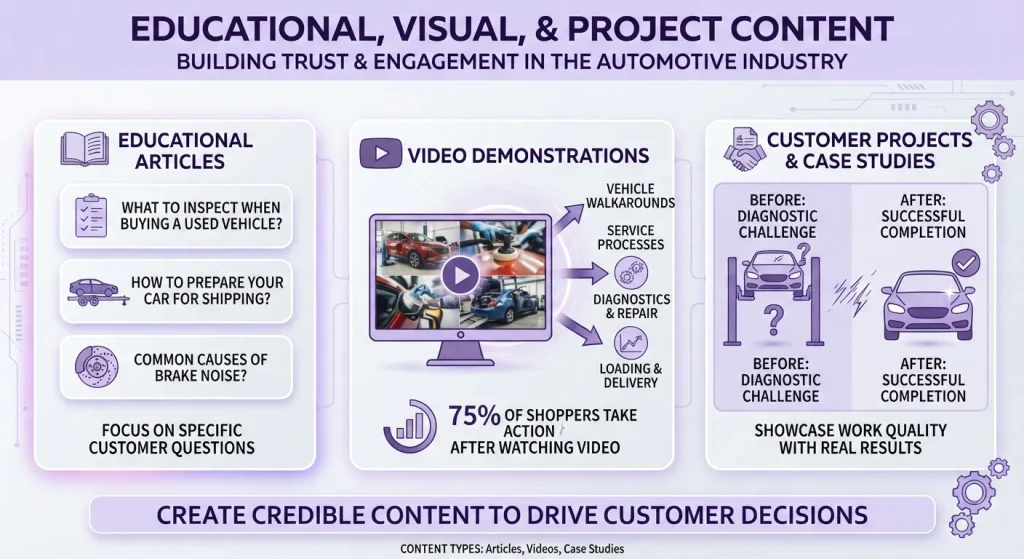
Articles are particularly useful when a subject requires detailed explanations or comparisons. A dealership could publish a guide explaining what to inspect when purchasing a used vehicle.
A transportation company could explain how customers should prepare their vehicles for shipping, while a repair shop could cover common causes of brake noise. The strongest topics answer specific questions rather than attempting to cover an entire industry in one article.
Video Demonstrations
Video allows customers to see products, services, and processes rather than relying exclusively on written explanations. Examples include:
- Dealerships: Vehicle walkarounds, interior demonstrations, and test drives.
- Detailing businesses: Paint correction, ceramic coating application, and interior restoration.
- Auto transport companies: Vehicle inspections, loading procedures, and delivery processes.
- Repair shops: Diagnostic demonstrations and explanations of completed repairs.
Video also offers measurable opportunities. According to Cox Automotive, 75% of shoppers took further action after watching automotive video content.
Customer Projects and Case Studies
Real customer projects give automotive businesses an opportunity to showcase the quality of their work through detailed case studies and before-and-after examples. For instance, a detailing business could document a paint correction project by showing the vehicle’s original condition, explaining the treatment process, and presenting the final results.
Similarly, an auto repair shop could walk readers through a diagnostic challenge, the steps taken to identify the fault, and the completed repair. Using genuine project details and customer-approved photographs makes this content more credible while helping potential customers understand the value of the services offered.
Automotive Content Marketing Strategies by Business Type
Automotive businesses serve customers with different needs, so their content should reflect the products and services they offer. A dealership needs to reach people comparing vehicles, while a transport company needs to answer questions about shipping. Detailing and repair businesses, on the other hand, can attract customers by addressing specific vehicle care and maintenance concerns.
Car Dealerships
Vehicle comparisons are a natural starting point for dealership content. Buyers often narrow down their choices by comparing models, trims, features, and ownership costs before visiting a showroom.
A car dealership selling several SUV models could publish a comparison of passenger capacity, cargo space, fuel economy, safety features, and available equipment. Other useful content could include new versus used vehicle guides, model walkarounds, and explanations of newer automotive technologies. These topics help potential buyers evaluate their options while bringing the dealership’s inventory into the conversation.
Auto Transportation Companies
Shipping a vehicle involves several decisions that customers may not have encountered before. They might be unsure whether to choose open or enclosed transport, how to prepare their vehicle, or what determines the final shipping cost.
A series of articles addressing these questions can make the process easier to understand. For example, a guide to open and enclosed car shipping could explain the differences in protection, pricing, and suitability for different vehicles. Companies serving multiple states could also develop useful destination-specific content covering popular routes, delivery arrangements, and transportation requirements. By targeting these searches, auto transport companies can reach people actively looking for shipping services and create more opportunities to generate qualified auto transport leads.
Car Detailing Businesses
Car detailing content benefits from showing rather than simply describing. Vehicle owners researching ceramic coating, paint correction, or interior detailing often want to understand what a treatment involves and what results they can expect.
Before-and-after photographs, short application demonstrations, and completed customer projects can make these services easier to evaluate. A paint correction case study, for instance, could show the vehicle’s condition before treatment, explain the work performed, and present the finished result. These examples can also help detailing businesses build trust with potential customers, an important part of attracting more detailing clients in a competitive local market.
Auto Repair Shops
For repair shops, content can begin with the problems drivers experience. Someone noticing an unusual engine temperature, a warning light, or changes in braking performance may search online to understand what could be wrong and whether professional attention is needed. Repair businesses can address these searches with practical articles covering:
- Common causes of engine overheating and potential warning signs.
- Brake problems that may require professional inspection.
- Battery failure symptoms and common causes.
- Dashboard warning lights and what they indicate.
- Vehicle maintenance intervals and diagnostic inspections.
The important distinction is to explain possible causes without presenting symptoms as definitive diagnoses. This gives readers useful information while demonstrating the shop’s knowledge of the repairs and inspections it performs.
Other Automotive Businesses
Other automotive businesses can develop content around their own products and services.
| Business type | Content opportunities |
| Towing companies | Roadside assistance, vehicle recovery, emergency towing |
| Auto glass shops | Windshield repair vs. replacement, glass damage |
| Tire retailers | Tire sizing, tread wear, seasonal tire selection |
| Car rental companies | Rental requirements, vehicle categories, booking considerations |
| Automotive parts suppliers | Part compatibility, replacement intervals, product comparisons |
How to Find Automotive Content Ideas
Rather than choosing topics randomly, businesses should use information from customers, search behavior, and their own services to identify useful subjects.
Customer Questions
Sales representatives, mechanics, service advisors, and transportation coordinators regularly encounter questions that can become articles or videos. For example, if an auto transport company frequently explains whether customers can ship non-operational vehicles, that question could become a dedicated resource.
Keyword Research
Keyword research tools can reveal what potential customers search for and which subjects have existing search demand.
Google Search Console is also useful for identifying queries that already generate impressions for a website. However, search volume should not be the only selection criterion. A specific topic with limited search demand may still attract highly relevant visitors interested in the company’s services.
Competitor Research
Reviewing competing websites can reveal subjects that deserve more detailed explanations. For example, competing detailing businesses might explain what ceramic coating is without covering the preparation process or maintenance requirements. That creates an opportunity to publish a more complete resource instead of simply reproducing existing content.
How to Plan and Distribute Automotive Content
Once relevant topics have been identified, businesses need to organize them into a consistent publishing plan and distribute them through appropriate channels.
Build a Content Calendar
A content calendar helps businesses organize topics around their services and customer needs. For example, a detailing company offering ceramic coating could plan the following articles:
| Topic | Content purpose |
| What Is Ceramic Coating? | Introduce the service |
| Ceramic Coating vs. Paint Protection Film | Compare alternatives |
| How Is Ceramic Coating Applied? | Explain the process |
| How to Maintain Ceramic Coating | Provide post-service guidance |
Related articles should link to one another and to the relevant commercial service page. For example, articles about ceramic coating can direct interested readers toward the service page, helping the business attract potential customers and generate more ceramic coating leads. This creates a connected group of resources rather than a collection of unrelated blog posts.
Distribute Content Across Different Channels
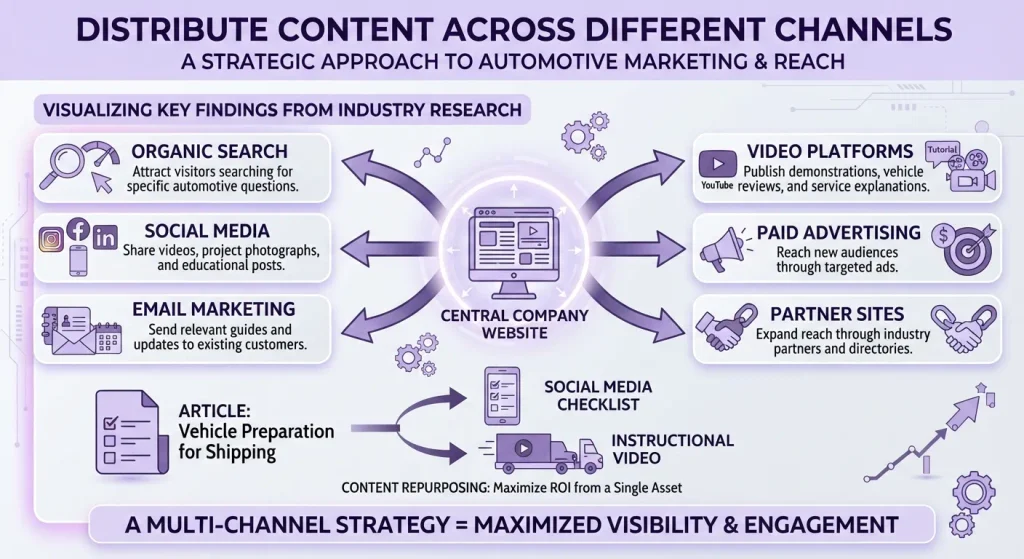
The company website should remain the central location for articles and detailed resources, but other channels can help distribute that information.
- Organic search: Attract visitors searching for specific automotive questions.
- Social media: Share videos, project photographs, and educational posts.
- Email marketing: Send relevant guides and updates to existing customers and subscribers.
- Video platforms: Publish demonstrations, vehicle reviews, and service explanations.
Content can also be repurposed. A detailed article about vehicle preparation for shipping could become a short checklist for social media and an instructional video for customers.
How to Measure Content Marketing Performance
Automotive businesses should evaluate content according to its contribution to website visibility, customer engagement, and commercial inquiries. The following measurements provide a useful starting point:
| Metric | What it tells you |
| Organic clicks and impressions | Whether content attracts search visibility |
| Organic traffic | How many visitors arrive from search |
| Service page visits | Whether readers explore commercial offerings |
| Contact form submissions | Whether content contributes to inquiries |
| Phone calls and quote requests | Whether visitors take commercial action |
| Assisted conversions | Whether content contributes to longer customer journeys |
A dealership might track test drive requests following visits to vehicle comparison guides. An auto transport company could measure quote requests from visitors who read shipping guides.
There is also an important distinction between website traffic and business results. An article attracting 500 highly relevant visitors may be more valuable than one attracting 5,000 visitors who have no interest in the company’s services.
Conclusion
Automotive content marketing works best when it reflects the products, services, and questions that define a particular business. Dealerships can help customers compare vehicles, transportation companies can explain shipping procedures, and detailing businesses can demonstrate specialized treatments.
Rather than publishing articles simply to keep a blog active, automotive companies should focus on creating resources that help customers research, compare, and evaluate their options.
Useful content, supported by real expertise and connected to relevant services, can turn an automotive business website into a valuable source of information and a consistent source of potential customer inquiries.