
B2B marketing continues to evolve as artificial intelligence, changing buyer behavior, and digital channels reshape how businesses discover and evaluate potential suppliers. Statistics on content marketing, lead generation, search, and marketing budgets help explain where organizations are investing and which challenges remain.
However, adoption does not always translate into effectiveness, and findings from different surveys can measure different audiences or outcomes. Our team at QuoteFlow Marketing, gathered the following B2B marketing statistics to examine buyer behavior, AI adoption, content performance, digital marketing channels, and investment trends.
Key B2B Marketing Statistics
- 95% of B2B marketers said their organizations use AI-powered applications. (DBS Interactive )
- 95% of winning vendors reportedly appeared on the buyer’s Day One shortlist. (6sense)
- More than half of B2B software buyers reportedly start their research with an AI chatbot more often than with Google. (DBS Interactive)
- 65% of marketers who consider their content effective credited relevance and quality as contributing factors. (Content Marketing Institute)
- 45% of B2B marketers planned to invest in AI-powered marketing tools in 2026, making them the leading investment priority in the survey. (Content Marketing Institute)
- 78% of B2B marketers reportedly use video, with more than half planning to increase their investment. (DSMN8)
- Average marketing budgets represented approximately 8% of company revenue in both 2025 and 2026. (Gartner)
- Email marketing delivered an average reported return of approximately $36 for every dollar spent. (DBS Interactive)
B2B Buyer Behavior Statistics
B2B buyers often research vendors before contacting sales teams. Understanding how early preferences develop can help marketers create content that supports both initial discovery and later evaluation.
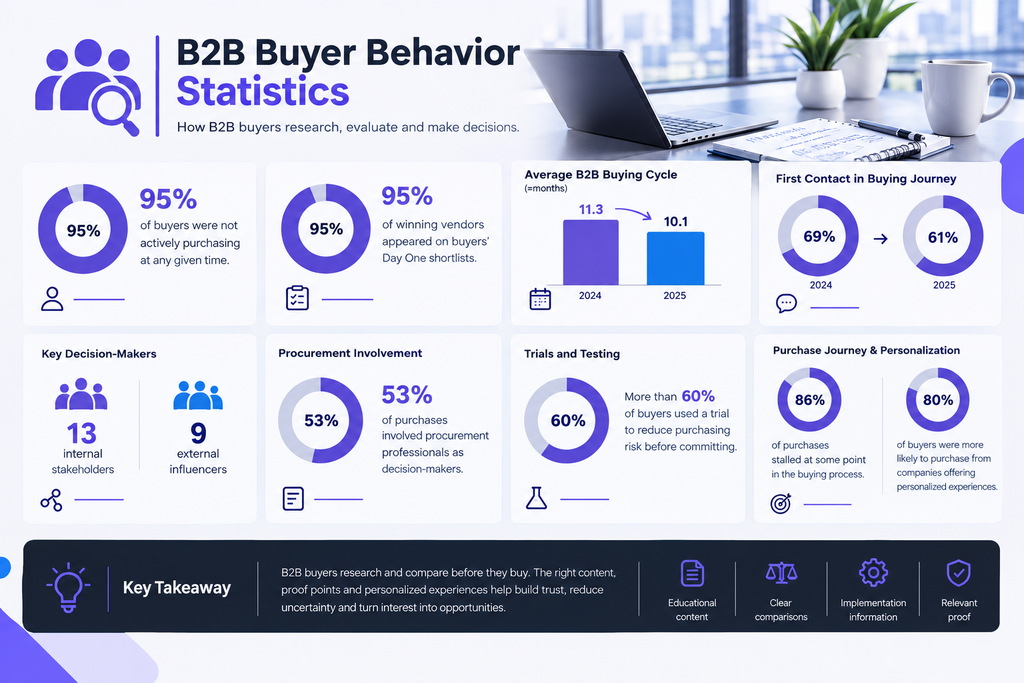
- 95% of buyers were reportedly not actively purchasing at any given time, according to the 2024 B2B Thought Leadership Impact Report. (Edelman)
- 95% of winning vendors reportedly appeared on buyers’ Day One shortlists. (6sense)
- Average B2B buying cycles declined from 11.3 months in 2024 to 10.1 months in 2025. (6sense)
- First contact with vendors shifted from 69% to 61% of the buying journey between 2024 and 2025. (Directive)
- Complex B2B purchases involved an average of 13 internal stakeholders and nine external influencers. (Forrester)
- Procurement professionals participated as decision-makers in 53% of business buying cycles. (Forrester)
- More than 60% of business buyers reportedly used a trial to reduce purchasing risk before committing. (Forrester)
- 86% of B2B purchases reportedly stalled at some point during the buying process. (DBS Interactive)
- 80% of business buyers were reportedly more likely to purchase from companies offering personalized experiences. (Lead Forensics)
These findings highlight the importance of building familiarity before a prospect contacts sales. Educational resources, clear comparisons, implementation information, and relevant proof can help buyers evaluate vendors and reduce uncertainty.
AI Adoption and AI Search Statistics
AI is becoming part of marketing workflows while also influencing how potential customers research products and services. The B2B marketing statistics in AI adoption and search show widespread adoption, although implementation maturity varies between organizations.
- 95% of B2B marketers said their organizations use AI-powered applications. (Content Marketing Institute)
- 68% of B2B marketers described their organization’s AI implementation as exploratory or developing. (Content Marketing Institute)
- 89% of B2B marketers reported using AI content creation tools. (Content Marketing Institute)
- Among marketers using AI content creation tools, 87% reported improved productivity, 80% improved operational efficiency, and 58% improved content quality. (Headley Media)
- 75% of marketing organizations reportedly used at least one form of AI. (Headley Media)
- More than half of B2B software buyers reportedly began their research with an AI chatbot more often than with Google. (DBS Interactive)
- 94% of B2B buyers reportedly used large language models to research their most recent purchase. (6sense)
- 36% of businesses reportedly use chatbots to improve their lead generation efforts, highlighting another way AI can support customer acquisition. (AI Chatbot Statistics by QuoteFlow Marketing)
- OpenAI reported more than 900 million weekly active ChatGPT users by February 2026. (Omnibound)
- Google AI Overviews appeared on close to half of BrightEdge’s tracked queries in early 2026, representing a reported 58% year-over-year increase. (DBS Interactive)
These figures measure different aspects of AI adoption and use. Overall platform audiences should not be confused with B2B buyer adoption, and using AI tools does not necessarily mean that an organization has integrated them across its operations.
B2B Content Marketing and Video Statistics
Content marketing remains important for educating buyers, building credibility, and supporting purchasing decisions. The available research emphasizes quality and relevance alongside investment in new formats.
- 65% of marketers who considered their content effective cited relevance and quality as contributing factors. (Content Marketing Institute)
- 81% of technology marketers whose content strategies improved credited strategic refinement as a factor. (Headley Media)
- 51% of those technology marketers cited new tools, including AI and automation, as contributing factors to improvement. (Content Marketing Institute)
- 40% of B2B marketers identified creating content that prompts action or conversion as a challenge. (Content Marketing Institute)
- 39% identified resource constraints as a content marketing challenge. (Content Marketing Institute)
- 78% of B2B marketers reportedly used video, with more than half planning to increase investment. (DSMN8)
- 41% of marketers identified short-form video as the video format delivering the highest ROI. (DSMN8)
- 80% of marketers surveyed by HubSpot reported using AI for content creation. (HubSpot)
- 75% of marketers surveyed by HubSpot reported using AI for media production. (HubSpot)
- 83% of marketers surveyed by HubSpot expected to produce more content with AI. (Headley Media)
- Gated content demand reportedly increased 83.8% between 2020 and 2025, based on an analysis of 7.9 million registrations. (NetLine)
- Registrations for AI-related content reportedly increased 186%. (NetLine)
The findings suggest that content planning involves more than increasing publication frequency. Marketers also need to understand what their audiences want to learn, which formats suit their needs, and whether the content helps move prospects toward meaningful business decisions.
B2B SEO, Social Media, and Email Marketing Statistics
Search, social media, and email support different parts of the B2B buyer journey. Their value depends on the audience, the type of content distributed, and the outcome being measured.
SEO and AI Search
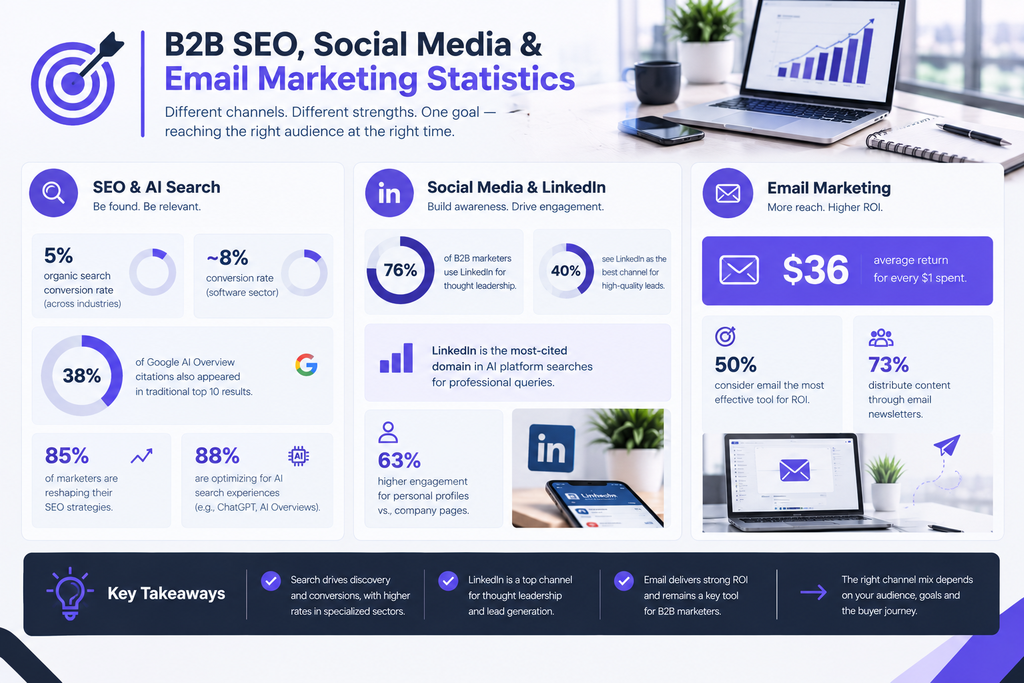
- Organic search converted at approximately 5% across industries, with the software sector reaching nearly 8%. (DBS Interactive)
- Approximately 38% of Google AI Overview citations also appeared in the traditional top 10 results for the same query. (Google AI Overviews Statistics by QuoteFlow Marketing)
- 85% of marketers surveyed by Salesforce said they were reshaping their SEO strategies. (Salesforce)
- 88% of marketers surveyed by Salesforce reported optimizing for AI-driven search experiences, including ChatGPT and Google AI Overviews. (Salesforce)
Social Media and LinkedIn
- 76% of B2B marketers identified LinkedIn as one of their most effective channels for publishing thought leadership. (DBS Interactive)
- 40% of marketers identified LinkedIn as the most effective way to generate high-quality leads. (DSMN8)
- LinkedIn was the most-cited domain across AI platforms for professional queries in an analysis covering late 2025 and early 2026. (DBS Interactive)
- Personal LinkedIn profiles generated 63% higher engagement than company pages in Metricool’s 2026 study. (DBS Interactive)
Email Marketing
- Email marketing delivered an average reported return of approximately $36 for every dollar spent. (DBS Interactive)
- 50% of marketers reportedly considered email the most effective marketing tool for ROI. (Lead Forensics)
- 73% of B2B marketers reportedly distributed content through email newsletters. (Book Your Data)
These B2B marketing statistics describe different outcomes, including conversion rates, channel effectiveness, engagement, and reported ROI. They should not be interpreted as a universal ranking of marketing channels, since the best mix depends on the business model and buying journey.
B2B Lead Generation and Conversion Statistics
Generating leads remains a priority for B2B marketers, but lead volume alone does not establish whether a campaign is producing valuable business opportunities. Lead quality, conversion rates, and the time needed to reach a decision also matter.
- 91% of marketers reportedly identified lead generation as a top priority. (Book Your Data)
- 65% of businesses reportedly struggled to generate website traffic and leads. (Book Your Data)
- 54% of marketers reportedly struggled with lead quality. (WebFX)
- 41% of marketers reportedly struggled to generate more leads. (WebFX)
- 53% of marketers reportedly spent at least half their marketing budget on lead generation. (WebFX)
- TrustRadius reportedly doubled click-through rates after introducing a sticky call-to-action banner. (Lead Forensics)
- Calendly reportedly improved sign-ups by 30% after optimizing form fields and layout. (Lead Forensics)
- Willo reportedly increased conversions by 57% after using a single call to action and a more personalized experience for the education sector. (Lead Forensics)
The case studies demonstrate reported results from individual website changes, not guaranteed improvements for other businesses. They also reinforce the importance of testing calls to action, forms, and page experiences rather than assuming that increased traffic alone will improve lead generation.
B2B Marketing Budget and ROI Statistics
Marketing budgets influence how businesses balance content production, paid media, technology, staffing, and measurement. The supplied research indicates that investment priorities are changing even as many organizations continue to face resource constraints.
- Marketing budgets averaged approximately 8% of company revenue in both 2025 and 2026. (Gartner)
- CMOs allocated approximately 15% of their marketing budgets to AI initiatives. (Gartner)
- Organizations reporting mature AI readiness allocated approximately 21% of their marketing budgets to AI. (Gartner)
- 56% of CMOs said their marketing organizations lacked the budget required to deliver their 2026 strategies. (DBS Interactive)
- 45% of B2B marketers planned to invest in AI-powered marketing tools in 2026. (Content Marketing Institute)
- 33% planned to invest in events and experiential marketing. (Content Marketing Institute)
- 32% planned to invest in owned media, including websites, blogs, email, and other content assets. (Content Marketing Institute)
- 70% of B2B marketers reportedly faced pressure to demonstrate marketing ROI. (Lead Forensics)
- Organizations with at least 1,000 employees reportedly had an average content marketing budget of $405,000, compared with $81,500 for organizations with 1–99 employees. (Lead Forensics)
These figures cover different budget measures, organization sizes, and survey questions. They should not be treated as directly interchangeable. In particular, planned investments are not the same as actual spending, and reported AI budget allocations do not establish the financial returns those investments will produce.
Conclusion
B2B marketing statistics show that buyers are conducting substantial research before contacting vendors, AI is changing both content production and discovery, and content relevance remains an important factor in reported marketing effectiveness. Video, LinkedIn, email, organic search, and website optimization continue to feature in strategies for reaching and converting business audiences.
However, the figures vary by publisher, survey population, and measurement method. Adoption rates do not guarantee results, case studies do not establish universal outcomes, and budget plans do not necessarily reflect final spending. The most useful approach is to evaluate each statistic in context and connect marketing decisions to measurable business objectives.