
Inbound marketing has become a core strategy for businesses looking to attract customers through valuable content, search visibility, and personalized experiences. Unlike traditional outbound marketing, which relies on pushing messages to audiences, inbound marketing focuses on creating resources that help potential customers discover, evaluate, and choose a solution.
From content marketing and SEO to email nurturing and automation, inbound strategies continue to demonstrate measurable results. Our team at QuoteFlow Marketing gathered top inbound marketing statistics showing how businesses are using digital channels to generate leads, reduce acquisition costs, and improve customer engagement.
Inbound Marketing Statistics ROI
Inbound marketing continues to gain popularity because businesses can generate more qualified opportunities while spending less compared with traditional marketing methods. The following statistics demonstrate the financial impact of inbound strategies:
- Inbound marketing generates three times more leads per dollar than traditional marketing methods.
- Content marketing generates three times more leads while costing 62% less than traditional marketing.
- Lead acquisition costs for inbound marketing are at least 67% lower than outbound marketing.
- Inbound leads acquired after five months of consistent inbound marketing can become 80% less expensive than outbound leads.
- Companies focusing on inbound marketing save approximately $14 per customer acquisition compared with traditional marketing.
- Inbound marketing tactics generate 54% more leads than outbound marketing tactics.
These numbers show why businesses are shifting budgets toward inbound channels that continue producing results beyond the initial campaign period.
Content Marketing Statistics
Content marketing is one of the most important parts of inbound marketing because it helps businesses attract prospects before they are ready to make a purchase. Educational content allows companies to answer customer questions, build authority, and influence buying decisions. Key content inbound marketing statistics include:
- 93% of B2B marketers use content marketing as part of their strategy.
- 48% of B2B buyers consume three to five pieces of content before contacting sales.
- 72% of marketers say content marketing helps educate their audience.
- 80% of companies that are extremely successful with content marketing have a documented strategy.
- 88% of successful content marketers prioritize audience information needs over sales messaging.
Content also plays a major role in purchase decisions. Research shows that buyers increasingly rely on educational resources before engaging with sales teams, making content a key driver of inbound growth.
Blogging and SEO Statistics
Blogging and search engine optimization remain two of the strongest inbound marketing channels because they help businesses attract users actively searching for information. Unlike paid campaigns, organic content can continue generating traffic and leads long after publication. Important blogging and SEO statistics include:
- Businesses that blog receive 55% more website visitors than businesses that do not blog.
- Companies with blogs generate 67% more leads monthly compared with companies without blogs.
- 77% of internet users regularly read at least one company blog.
- Companies that blog generate 97% more inbound links than companies without blogs.
- 68% of online experiences begin with a search engine.
- Organic search generates more than 50% of website traffic.
Long-form content also performs strongly within inbound strategies. Research shows that longer articles generate more links and can create additional opportunities for businesses to attract organic visitors.
Lead Generation Statistics
Generating qualified leads is one of the primary goals of inbound marketing. By attracting prospects through content, SEO, and valuable resources, businesses can reach people who already have an interest in their products or services. Inbound lead generation statistics show:
- 60% of marketers say inbound sources such as SEO and blog content provide their highest-quality leads.
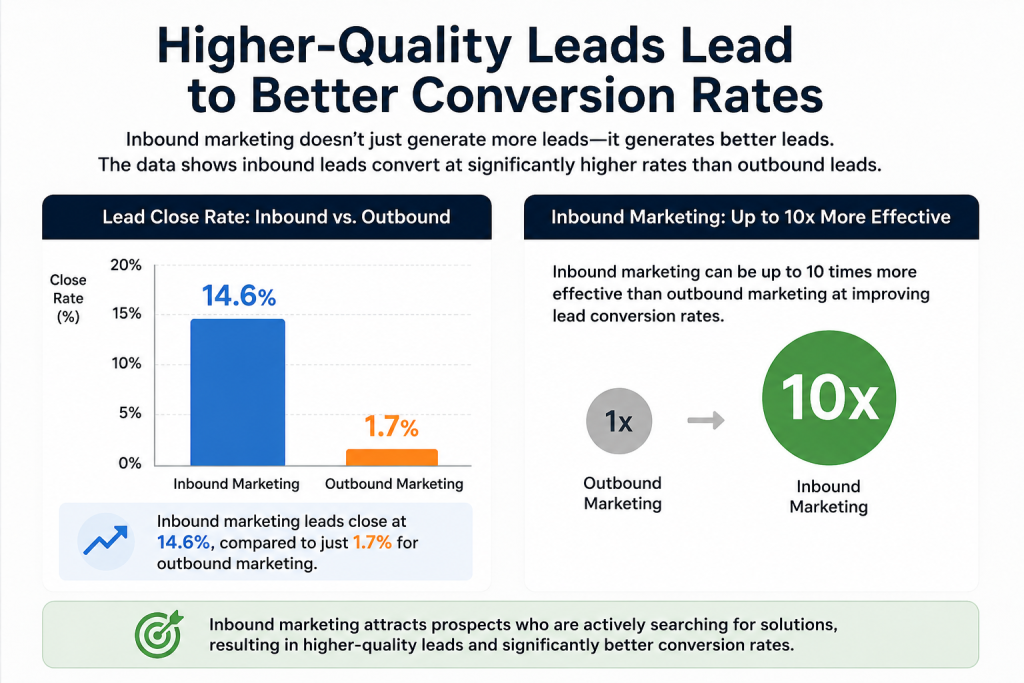
- Inbound marketing leads have a 14.6% close rate compared with 1.7% for outbound leads.
- Other research suggests inbound marketing can be 10 times more effective than outbound marketing at improving lead conversion rates, reinforcing its ability to attract prospects who are already researching solutions instead of interrupting people with unsolicited promotions.
- 67% of marketers report that content marketing generates leads.
- 80% of B2B companies use content marketing for lead generation.
- Companies publishing 401+ blog posts generate nearly three times more leads than companies publishing fewer than 200 posts.
- Businesses using inbound marketing increased lead generation by 83.9% within seven months.
Inbound marketing improves lead quality because prospects typically discover businesses while researching solutions rather than being interrupted by promotional messages.
Lead Nurturing and Email Inbound Marketing Statistics
Attracting leads is only the first step. Successful inbound marketing strategies continue engaging prospects through email campaigns, personalized content, and automated follow-ups. Email and lead nurturing statistics include:
- Companies with effective lead nurturing generate 50% more sales-ready leads at 33% lower costs.
- Nurtured leads make 47% larger purchases than non-nurtured leads.
- Email marketing generates an average return of $36 for every $1 spent.
- 53% of marketers say email marketing is their most effective channel for early-stage lead generation.
- 71% of B2B marketers use automation in their email marketing efforts.
- Automated emails can improve conversion rates by 2,270% compared with standard email campaigns.
Email remains one of the strongest inbound channels because it allows businesses to continue providing value after a prospect has shown interest.
Social Media and Video Marketing Statistics
Inbound marketing has expanded beyond blogs and search engines. Social media and video content now play an important role in helping businesses attract audiences, increase engagement, and generate new opportunities. Social and video inbound marketing statistics include:
- 57% of internet users discover new brands or products through social media.
- 88% of marketers believe social media provides a positive ROI.
- 73% of social media users say they will buy from a competitor if brands do not respond to them online.
- 87% of marketers using video say it increases website traffic.
- 80% of video marketers report that video directly increases sales.
- 92% of marketers say video is an important element of their inbound marketing strategy.
As consumers increasingly prefer interactive and educational content, video and social platforms have become important channels for attracting and engaging potential customers.
AI and Marketing Automation Statistics
Automation and artificial intelligence are becoming increasingly important components of inbound marketing. Businesses are using these technologies to personalize communication, improve efficiency, and manage larger audiences. Key AI and automation statistics include:
- 76% of companies use inbound marketing automation.
- Companies that automate lead nurturing can see a 10% increase in revenue within 6–9 months.
- 61% of marketers plan to increase AI usage for personalization and efficiency.
- 89% of marketers use generative AI for content creation.
- 63% of businesses automate email marketing, while 50% automate social media activities.
Automation allows businesses to maintain consistent engagement while reducing repetitive manual tasks.
Key Takeaways
- Inbound marketing statistics show that inbound marketing produces more leads at a lower cost than many traditional marketing approaches.
- Content marketing, blogging, and SEO remain the foundation of inbound growth.
- Lead nurturing improves conversion rates by keeping prospects engaged throughout the buying journey.
- Email marketing continues to deliver strong ROI and supports long-term customer relationships.
- Video, social media, AI, and automation are shaping the future of inbound marketing.
Conclusion
The latest inbound marketing statistics show that businesses are increasingly relying on strategies built around value, education, and customer relationships. Content, SEO, email marketing, automation, and social media continue to prove their ability to attract qualified prospects and support sustainable growth.
As buyer behavior continues changing, companies that invest in inbound marketing can create stronger connections with audiences while reducing dependence on traditional outbound methods.
Sources Used: