
Legal marketing continues to evolve as prospective clients increasingly rely on online search, digital platforms, and attorney reviews when choosing legal representation. Law firms are also investing in SEO, content marketing, technology, and artificial intelligence to attract new clients and strengthen their market presence.
The following legal marketing statistics explore industry spending, client behavior, lead generation, and emerging marketing trends, providing insights into how law firms attract clients and measure marketing performance. The figures come from multiple research sources and reflect different survey populations, methodologies, and reporting periods.
Key Legal Marketing Statistics
- 92.4% of consumers research a legal issue online before contacting an attorney.
- 90% of law firms have a website, according to the ABA’s 2024 survey.
- 68.2% of consumers consider reviews and testimonials particularly helpful when evaluating attorneys.
- 54% of law firms increased their marketing budgets after inflation adjustments.
- 57% of law firm CMOs consider written content development very effective.
- 52% of law firms identify video as a primary driver of new business.
- 72% of consumers move on if a law firm does not respond within 24 hours.
- 79% of legal professionals use AI in their firms, according to Clio’s 2025 research.
- 80% of firms reportedly do not receive regular marketing performance reports.
- 3.9 times: Firms with a visible AI strategy are much more likely to report at least one form of ROI than firms without significant AI plans.
These findings show that legal marketing involves more than generating website traffic or maintaining a social media presence. Search visibility, reputation, client communication, and the ability to connect marketing activity with business outcomes all influence how law firms approach growth.
Law Firm Marketing Budgets, Spending, and ROI Statistics
Legal marketing statistics reveal how law firms are investing in marketing, technology, and business development to remain competitive and attract new clients. Budget increases also reflect the growing number of channels and tools available to legal professionals.
Law Firm Marketing Budget Trends
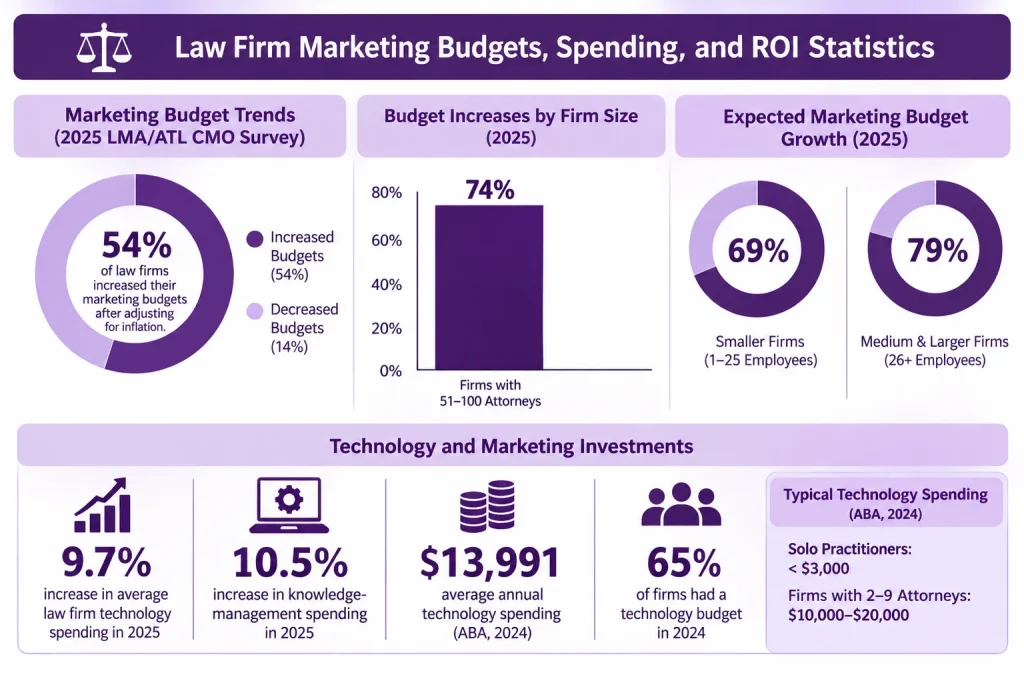
According to the 2025 LMA/ATL CMO Survey:
- 54% of law firms increased their marketing budgets after adjusting for inflation.
- 14% reported decreasing their marketing budgets.
- 74% of firms with 51–100 attorneys increased their budgets, representing the highest proportion among the surveyed firm-size groups.
Other research also indicates that firms expect marketing investment to continue growing. Rankings.io’s 2025 State of Law Firm Marketing report found that 69% of smaller firms with 1–25 employees and 79% of medium and larger firms with 26 or more employees expected their marketing budgets to increase.
Technology and Marketing Investments
Technology is another important area of legal industry spending. According to the Thomson Reuters Institute and Georgetown Law’s 2026 Report on the State of the U.S. Legal Market, average law firm technology spending increased by 9.7% in 2025. Knowledge-management spending increased by 10.5% during the same period.
The ABA’s 2024 Technology Survey also found that:
- Average annual law firm technology spending reached $13,991.
- Solo practitioners typically spent less than $3,000.
- Firms with 2–9 attorneys generally spent between $10,000 and $20,000.
- 65% of firms had a technology budget in 2024.
These figures cover technology spending rather than marketing expenditure alone. However, they illustrate the broader investment firms are making in the systems and infrastructure that support their operations and business development.
Sources: (LMA/ATL CMO Survey, Pareto Legal, Rankings io, Thomson Reuters Institute, ABA)
Client Behavior and Attorney Selection Statistics
Prospective clients often research attorneys before making contact. Search engines, law firm websites, online reviews, and personal recommendations all contribute to how consumers evaluate legal services.
Online Search and Attorney Discovery
The Martindale-Avvo Legal Consumer Report 2024 found that:
- 92.4% of consumers research a legal issue online before contacting an attorney.
- 93.3% want to conduct additional research into attorneys they discover through search engines before hiring.
- Among consumers who hired an attorney, 96.3% wanted to research the attorney further.
- 61% of consumers who receive an attorney referral research that professional’s reputation online.
- Only 4% of consumers do not investigate an attorney recommended to them.
Other findings from the supplied research indicate that more than 75% of prospective clients visit between two and five websites before contacting an attorney.
Reviews and Reputation Management
Online reputation is another important factor in attorney selection.
According to Pareto Legal report, 68.2% of consumers consider reviews and testimonials particularly helpful when evaluating attorneys.
The research also reports that:
- 53% of consumers would not consider a law firm with a rating below four stars, compared with 42% in 2024.
- 51% of consumers do not look beyond the fifth search result when researching attorneys.
Consumers also evaluate several reputation-related factors:
| Reputation factor | Consumers considering it |
| Average review score | 58.8% |
| Number of reviews | 54.3% |
| Review recency | 40.8% |
| Attorney endorsements | 35.1% |
| Third-party expertise ratings | 29.4% |
| Awards and certifications | 26.0% |
Pricing and fees also influence attorney selection, with 61.6% of consumers identifying them as a consideration. Responsiveness was important to 58%, while 53% considered peer reputation.
These findings show that receiving a referral or appearing in search results does not necessarily end the selection process. Prospective clients often continue researching an attorney’s experience, reputation, reviews, and available information before deciding whom to contact.
Sources: (Martindale-Avvo, My Case, Pareto Legal)
Law Firm SEO and Website Statistics
Legal marketing statistics highlight the importance of search engine visibility and website performance, as prospective clients frequently use online resources to find and evaluate attorneys.
Search Engine Optimization and Organic Search
The supplied research highlights several SEO-related findings:
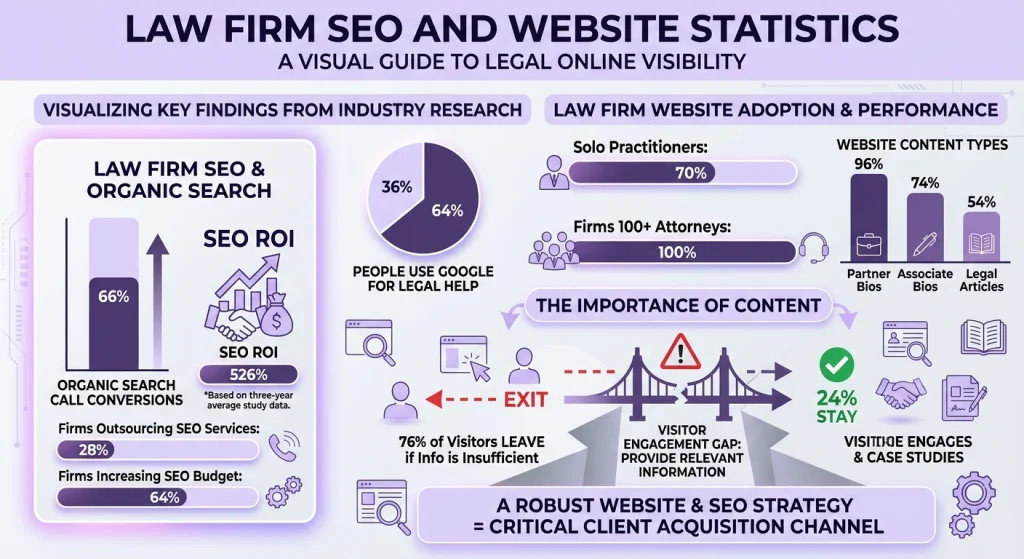
- 64% of people reportedly use Google to find legal help.
- Organic search drives up to 66% of legal call conversions.
- FirstPageSage reports an average three-year SEO ROI of 526% for law firms.
- 28% of law firms outsource SEO services.
- 64% of law firms reportedly plan to increase their website optimization budgets.
These figures demonstrate the importance of organic search as an attorney discovery and client acquisition channel. However, reported SEO returns and conversion figures depend on the underlying research methodology and should not be treated as guaranteed results for individual firms.
Law Firm Website Adoption and Performance
The ABA’s 2024 Websites and Marketing Technology Survey found that 90% of law firms have a website, down from 94% in 2022.
Website adoption varies by firm size:
- 70% of solo practitioners reported having a website in 2024, compared with 61% in 2022.
- 100% of firms with 100 or more attorneys had a website.
Website content also plays a role in how firms present their services and experience. According to the ABA statistics, partner biographies appeared on 96% of law firm websites, associate biographies on 74%, and legal articles on 54%.
Other findings indicate that 76% of visitors leave a law firm website if they cannot find sufficient information about the firm.
These statistics highlight why a law firm’s website needs to provide more than basic contact information. Practice-area descriptions, attorney biographies, relevant legal content, and accessible contact details can help prospective clients evaluate whether a firm meets their needs.
Sources: (ABA, FirstPageSage, SeoProfy, iLawyer Marketing)
Legal Content, Social Media, and Video Marketing Statistics
Content and social media allow law firms to communicate their expertise, distribute useful information, and maintain visibility among prospective clients. Video has also become a more prominent part of legal marketing strategies.
Legal Content Marketing and Blogging
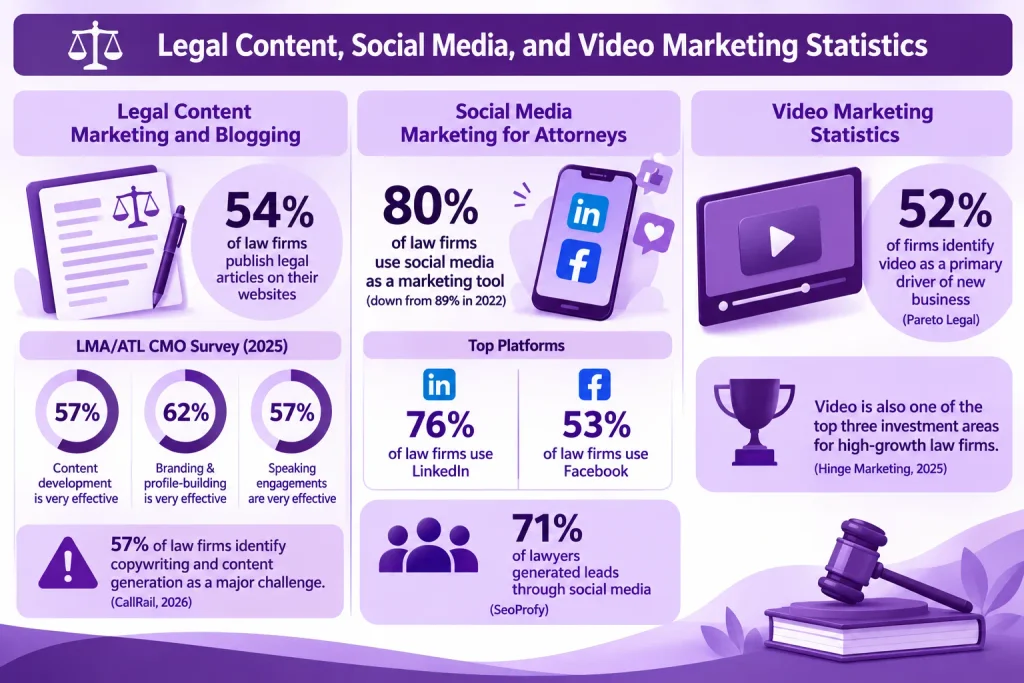
The ABA’s research found that 54% of law firms publish legal articles on their websites.
The 2025 LMA/ATL CMO Survey reported that:
- 57% of law firm CMOs consider written content development very effective.
- 62% consider branding and profile-building activities very effective.
- 57% consider in-person speaking engagements very effective.
However, producing content remains a challenge. CallRail’s 2026 Legal Marketing Trends research found that 57% of law firms identify copywriting and content generation as significant challenges.
Social Media Marketing for Attorneys
Social media remains widely used across the legal industry, although reported adoption rates vary by survey.
According to Pareto Legal, 80% of law firms use social media as a marketing tool, down from 89% in 2022.
LinkedIn and Facebook are among the most frequently used platforms:
- 76% of law firms identify LinkedIn as a primary social media platform.
- 53% identify Facebook as a primary platform.
- 71% of lawyers reportedly generated leads through social media.
The findings suggest that social media serves different purposes, including professional visibility, content distribution, relationship development, and client acquisition.
Video Marketing Statistics
Video is another channel receiving attention from law firms.
According to Pareto Legal, 52% of firms identify video as a primary driver of new business. Hinge Marketing’s 2025 High Growth Study also identified video as one of the three highest investment areas among high-growth firms.
These figures measure different aspects of video marketing: one concerns its reported contribution to new business, while the other concerns investment priorities. They should not be interpreted as the percentage of all law firms using video.
Sources: (ABA, LMA/ATL CMO Survey, CallRail, Pareto Legal, AttorneyAtWork, Hinge Marketing)
Legal Advertising and Traditional Marketing Statistics
Law firms use a combination of digital advertising, professional events, sponsorships, print, and other traditional channels to reach potential clients. The effectiveness of these approaches can vary depending on the firm’s practice areas, target audience, and marketing objectives.
Paid Search and Digital Advertising
Paid search remains an important acquisition channel for many law firms. Pareto Legal research found that:
- 51% of law firms identify paid search as one of their top three drivers of new business.
- Among larger firms, 63% identify paid search as a leading acquisition channel.
However, paid advertising does not always deliver the expected return. CallRail research found that 78% of law firms use paid search, while 82% describe its ROI as underwhelming.
These figures illustrate why advertising expenditure should be evaluated against the quality of inquiries and the business generated, rather than clicks alone.
Traditional Legal Marketing Channels
Traditional marketing continues to play a role in law firm business development.
According to the ABA statistics:
- 44% of law firms sponsor or attend events.
- 24% use print advertising.
- 12% use direct mail.
Professional events and sponsorships can also provide opportunities to build relationships with referral sources and other professionals. Their value, however, depends on whether they reach relevant audiences and contribute to the firm’s business development objectives.
Sources: (CallRail, Pareto Legal, ABA, MyCase)
Law Firm Lead Generation and Client Intake Statistics
Legal lead generation is only one part of legal client acquisition. Law firms must also respond to prospective clients, assess their needs, and move suitable inquiries through the intake process.
Legal Lead Sources and Conversion Rates
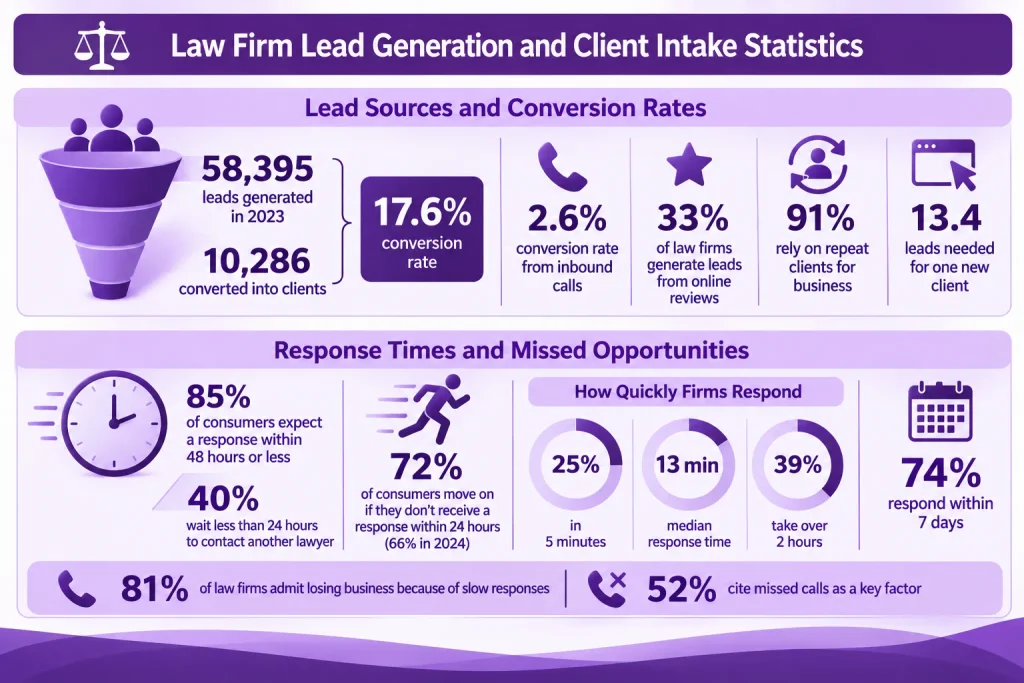
The 2024 Legal Industry Trends Report from MyCase recorded 58,395 leads captured through customized intake forms among its customers in 2023. Of those leads, 10,286 converted into clients, representing an average conversion rate of 17.6%.
Other findings from the supplied research include:
- Legal-sector inbound calls have a reported conversion rate of 2.6%.
- 33% of law firms reportedly generate leads through online review platforms such as Yelp.
- 91% of law firms rely on repeat clients for business.
- Martindale research estimates that an average of 13.4 leads are needed to produce one new client.
These figures come from different studies and measure different lead sources and conversion processes. They should not be combined into a single industry-wide conversion benchmark.
Response Times and Missed Opportunities
The speed at which a firm responds to inquiries can influence whether a prospective client continues considering its services.
According to the Martindale-Avvo Legal Consumer Report 2024:
- 85% of consumers expect a response within 48 hours or less.
- 40% wait less than 24 hours before contacting another lawyer.
Pareto Legal found that 72% of consumers move on if they do not receive a response within 24 hours, compared with 66% in 2024.
Law firm response practices also vary considerably. Hennessey Digital’s 2025 Lead Form Response Time Study reported that:
- 25% of firms respond to online leads within five minutes.
- The median response time is 13 minutes.
- 39% take more than two hours to respond or never respond.
- 74% respond to online leads within seven days.
CallRail’s 2026 research found that 81% of law firms admit losing business because of slow responses. Missed calls were identified as a contributing factor by 52% of firms.
These findings highlight the importance of connecting lead generation with an effective intake process. Marketing can attract prospective clients, but delayed responses and missed inquiries can prevent firms from converting that interest into new business.
Sources: (MyCase, Ruler Analytics, Martindale-Avvo, Pareto Legal, Hennessey Digital, CallRail)
AI Adoption and Emerging Legal Marketing Trends
Recent legal marketing statistics also highlight the growing role of artificial intelligence in law firm operations and client acquisition.
Artificial intelligence is becoming increasingly relevant to legal operations and marketing. Law firms are exploring AI for content creation, lead qualification, campaign personalization, and other activities, while consumers are beginning to use AI tools during their search for legal assistance.
Artificial Intelligence Adoption in Law Firms
Clio’s 2025 Legal Trends Report found that 79% of legal professionals use AI in their firms. The same research found that growing firms use AI at twice the rate of stable and shrinking firms.
Other research provides additional context:
- 35% of firms reported regular or widespread AI use in the 2025 LMA/ATL CMO Survey.
- All firms reporting widespread AI adoption in that survey had 100 or more attorneys.
- 31% of legal respondents reported implementing generative AI at work, while 21% of law firms reported firm-level adoption.
These figures measure different forms of AI adoption, including individual professional use and firm-wide implementation. They therefore represent different survey findings rather than directly comparable adoption rates.
AI in Marketing and Client Discovery
A research identified several marketing-related applications of AI among law firms:
| AI marketing application | Firms reporting use |
| Personalizing campaigns and client experiences | 68% |
| Lead scoring and qualification | 55% |
| Attribution and ROI measurement | 53% |
| Content generation | 52% |
AI is also beginning to influence how prospective clients find legal services. According to Attorney at Law Magazine, 28% of consumers who used AI for a legal problem were directed by the AI to contact a lawyer. Additionally they reported that firms with a visible AI strategy were 3.9 times as likely to experience at least one form of ROI as firms without significant AI plans.
These findings suggest that AI adoption involves more than introducing new software. Firms are also considering how technology supports marketing strategy, client discovery, and business performance.
Sources: (Clio, Pareto Legal, LMA/ATL CMO Survey, SeoProfy)
Law Firm Marketing ROI, Measurement, and Accountability Statistics
Measuring marketing performance remains a challenge for law firms. Rankings, impressions, clicks, website visits, and social engagement can demonstrate activity, but they do not necessarily establish whether marketing is generating qualified inquiries or signed matters.
Marketing Reporting and Attribution
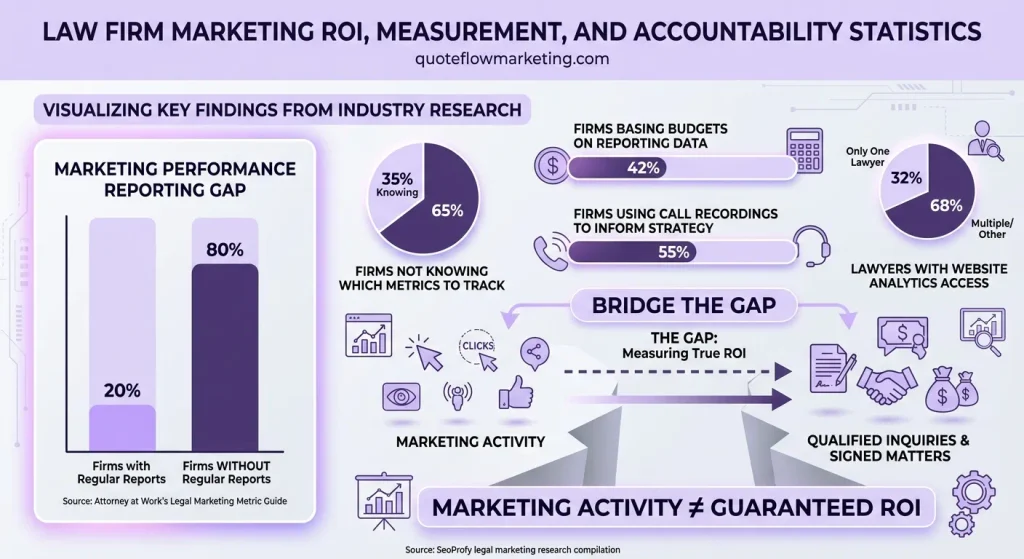
According to Attorney at Work’s legal marketing metric guide, 80% of law firms do not receive regular marketing performance reports.
SeoProfy’s compilation of legal marketing research also reports that:
- 65% of firms do not know which marketing metrics to track.
- 42% base their marketing budgets on reporting data.
- 55% use call recordings to inform marketing strategy.
- 32% have only one lawyer with access to website analytics.
These findings point to a gap between marketing activity and the information firms use to evaluate it.
Which Legal Marketing Metrics Matter?
Marketing reports often contain several measurements, but not all of them demonstrate business performance.
| Metric | What it measures |
| Impressions | How often content or advertising is displayed |
| Reach | The number of unique people exposed to content |
| Click-through rate (CTR) | The proportion of impressions that result in clicks |
| Bounce rate | The percentage of website visits that meet the platform’s bounce definition |
| Time on page | How long visitors spend on a page |
| Conversions | Actions such as calls, completed forms, or consultation bookings |
| Cost per click (CPC) | The average cost of an advertising click |
| Cost per lead (CPL) | The cost of generating a potential client inquiry |
For law firms, a conversion should reflect an action that matters to the firm’s intake process. A phone call, completed consultation request, or qualified inquiry may be more meaningful than a button click or page visit.
Sources: (SeoProfy, Attorney at Work)
Conclusion
Legal marketing statistics show how online search, attorney reputation, SEO, content, and social media influence how prospective clients discover and evaluate law firms. Meanwhile, AI adoption, changing client expectations, and evolving marketing channels continue to reshape the industry.
For law firms, effective marketing goes beyond generating visibility. It requires attracting relevant prospects, responding to inquiries, building credibility, and measuring how marketing investments contribute to qualified leads, new clients, and business growth.