
Voice search has become a natural part of how people search for information, find local businesses, shop online, and interact with their devices. As voice assistants continue to improve, they are changing both consumer behavior and the way businesses approach search engine optimization.
These changes also reflect broader industries, such as the insurance industry as shown in insurance marketing statistics, where agencies are increasingly investing in SEO, local search, and digital channels to connect with prospective customers. Our team gathered the latest voice search statistics, covering adoption, user behavior, smart speakers, voice commerce, and the SEO trends shaping voice search in 2026.
Key Voice Search Statistics
If you only remember a handful of numbers, these are among the most important voice search statistics from the research:
- More than 1 billion voice searches are performed every month.
- 8.4 billion voice assistants are active worldwide.
- Around 20.5% of people globally use voice search.
- 71% of consumers prefer voice search over typing.
- 90% of users believe voice search is easier than text-based searching.
- The average voice search query contains approximately 29 words.
- 76% of smart speaker owners perform local searches every week.
- 58% of consumers use voice search to find local business information.
- 40.7% of voice search answers come from Featured Snippets.
- Voice search result pages load 52% faster than the average webpage.
- 43% of smart speaker owners use voice commands while shopping online.
- The global voice commerce market is projected to reach $164 billion by 2028.
These figures demonstrate that voice search is no longer a niche technology. It has become an established part of how consumers search, shop, and interact with businesses online.
Voice Search Adoption Statistics
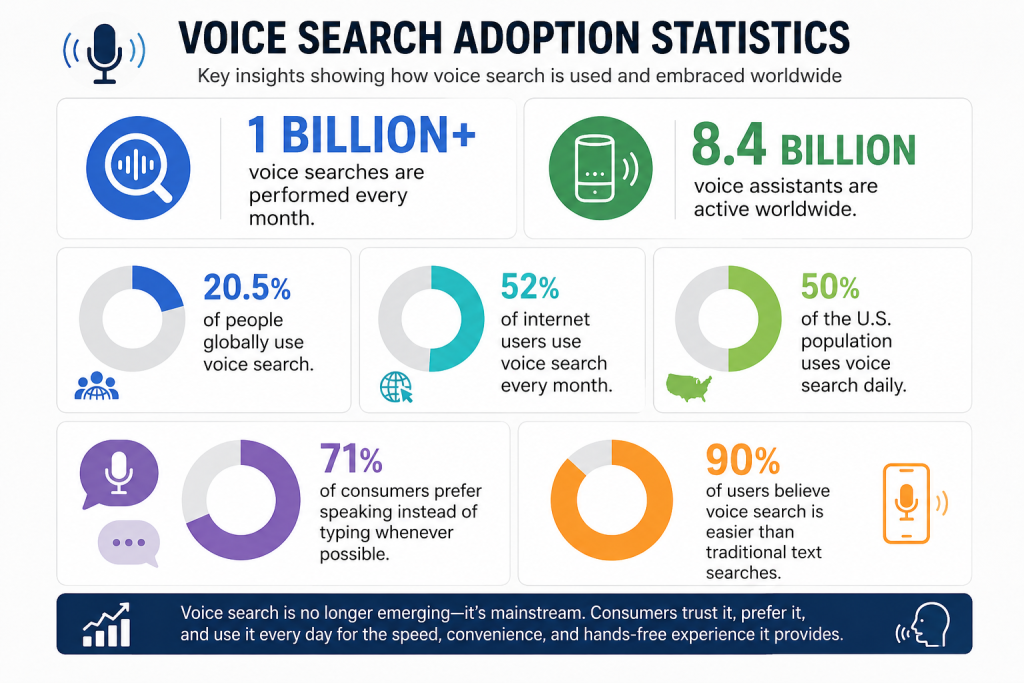
Voice technology is no longer limited to smartphones. It has expanded across smart speakers, vehicles, wearable devices, televisions, and home automation systems, making voice interactions a regular part of everyday life. Some of the most notable voice search adoption statistics include:
- More than 1 billion voice searches are performed every month.
- 8.4 billion voice assistants are active worldwide.
- Around 20.5% of people globally use voice search.
- Approximately 52% of internet users use voice search every month.
- Nearly 50% of the U.S. population uses voice search daily.
- 71% of consumers prefer speaking instead of typing whenever possible.
- 90% of users believe voice search is easier than traditional text searches.
These numbers demonstrate that voice search is no longer an emerging technology. Instead, it has become an established search behavior that many consumers rely on every day because it offers convenience, speed, and hands-free access to information.
Sources: (theStacc, DemandSage)
Voice Assistant and Smart Speaker Statistics
The growing popularity of voice search is closely tied to the widespread adoption of voice assistants and smart speakers. From smartphones to smart home devices, consumers are interacting with voice-enabled technology more than ever before. Key voice assistant and smart speaker statistics include:
- Approximately 103 million Americans have a smart speaker in their homes.
- 42% of U.S. households own at least one smart speaker.
- The average smart speaker household has 2.3 devices.
- 53% of smart speaker owners use their device every day.
- 65% say they cannot imagine going back to life without a smart speaker.
- 93% of users report being satisfied with their voice assistant’s performance.
- 52% of smart speakers are located in living rooms, 25% in bedrooms, and 22% in kitchens.
- Google Assistant and Siri each account for approximately 36% of voice assistant usage, while Alexa holds about 25%.
- Google Assistant supports 119 languages, making it one of the most widely accessible voice assistants worldwide.
These statistics demonstrate how voice assistants have become part of everyday life, with millions of households relying on them for everything from answering questions to controlling smart home devices and completing routine tasks.
Sources: (Digital Applied, Sixth City Marketing)
Voice Search User Behavior Statistics
Voice search differs significantly from traditional search behavior because people naturally speak differently than they type. Instead of entering short keyword phrases, users typically ask complete questions using conversational language. Studies show the average voice search query contains approximately 29 words, making voice searches considerably longer than standard text searches. Common question words frequently appear in voice searches, including:
- How
- What
- Where
- When
- Who
- Best
This conversational style explains why question-and-answer content often performs well for voice search optimization. Age also influences adoption rates. Among younger adults, 77% of people between the ages of 18 and 34 regularly use smartphones for voice searches. Usage gradually declines with older age groups, although adoption continues across all generations. Other notable behavior statistics include:
- Around 30% of internet users aged 16 to 64 use a voice assistant every week.
- 61% of adults between 25 and 64 expect to increase their voice assistant usage in the future.
- 72% of consumers have used voice assistance within the past six months.
- 70% of users choose voice search because it is faster and more convenient than typing.
These figures suggest that voice search has become a habitual behavior rather than an occasional convenience.
Sources: (theStacc, DemandSage, Yaguara, SEOmator)
Local Voice Search Statistics
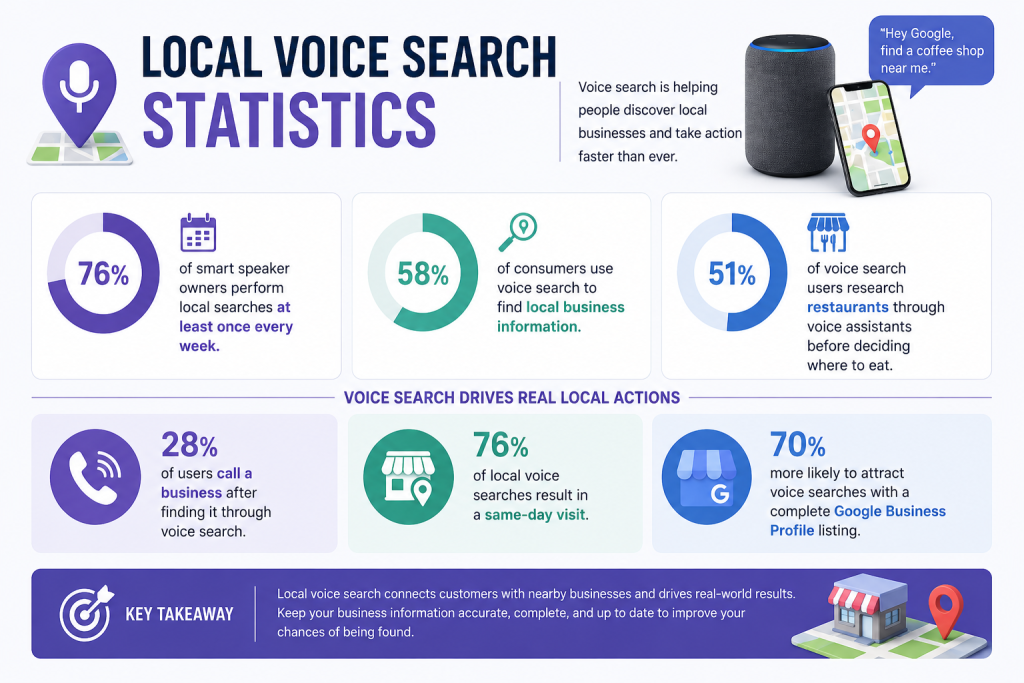
Local businesses continue to benefit from voice search because many spoken queries involve nearby products, services, or directions. Research indicates that 76% of smart speaker owners perform local searches at least once every week, while 58% of consumers use voice search specifically to find local business information.
Restaurants remain one of the most popular local search categories. Approximately 51% of voice search users research restaurants through voice assistants before deciding where to eat. Voice search also produces measurable business outcomes. Studies found that:
- 28% of users call a business after finding it through voice search.
- 76% of local voice searches result in a same-day visit.
- Businesses with complete Google Business Profile listings are 70% more likely to attract voice searches.
These statistics reinforce why local SEO continues to play an important role in voice search visibility. Businesses that maintain accurate location information, business hours, contact details, and customer reviews are better positioned to appear when users ask location-based questions.
SEO Voice Search Statistics
Voice search optimization builds on many traditional SEO best practices, but some ranking factors have a much greater influence on whether a page is selected as a spoken answer.
Many of these ranking signals also reflect broader inbound marketing statistics, where content relevance, website performance, and user intent remain key drivers of organic traffic. The latest research highlights several trends that businesses should pay attention to. Key voice search SEO statistics include:
- 40.7% of voice search answers come directly from Featured Snippets.
- Around 75% of spoken answers originate from pages ranking in Google’s top three organic results.
- Voice search result pages load 52% faster than the average webpage.
- The average page selected for voice search loads in approximately 4.6 seconds.
- Most voice search results come from HTTPS-secured websites.
- Pages selected for voice search commonly use structured data (Schema markup).
- The average page ranking for voice search contains approximately 2,300 words.
- Voice search queries are typically more conversational, making question-based content and direct answers especially important.
These statistics suggest that businesses don’t need a separate SEO strategy for voice search. Instead, focusing on high-quality content, fast page speeds, strong technical SEO, and clear answers to common user questions can significantly improve the chances of appearing in voice search results.
Sources: (theStacc, Sixth City Marketing, Marketing LTB)
Voice Commerce Statistics
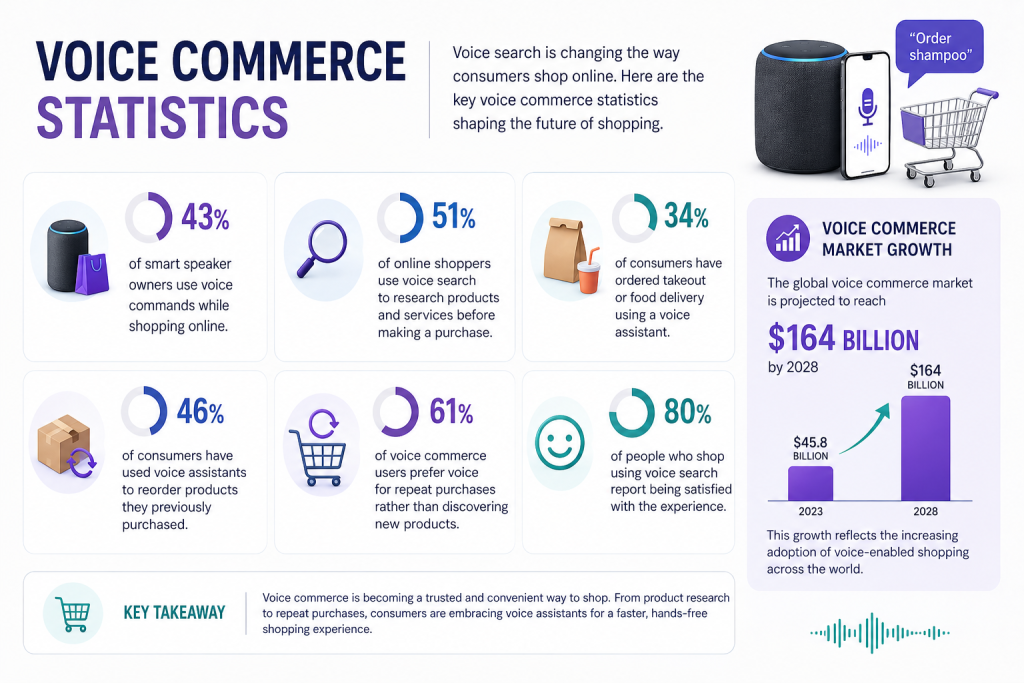
Voice search has evolved beyond answering questions. Today, consumers use voice assistants to research products, place orders, and make repeat purchases. The latest voice commerce statistics highlight how shopping behaviors continue to change.
- 43% of smart speaker owners use voice commands while shopping online.
- 51% of online shoppers use voice search to research products and services before making a purchase.
- 34% of consumers have ordered takeout or food delivery using a voice assistant.
- 46% of consumers have used voice assistants to reorder products they previously purchased.
- 61% of voice commerce users prefer voice for repeat purchases rather than discovering new products.
- 80% of people who shop using voice search report being satisfied with the experience.
- The global voice commerce market is projected to reach $164 billion by 2028, reflecting continued growth in voice-enabled shopping.
These statistics show that while traditional e-commerce remains the dominant shopping channel, voice commerce continues to gain traction, particularly for product research, routine purchases, and convenient reordering.
Sources: (theStacc, Sixth City Marketing, Digital Applied)
Voice Search Accuracy Statistics
The rapid adoption of voice search would not be possible without major improvements in speech recognition and natural language processing. Modern voice assistants are now capable of understanding spoken requests with impressive accuracy, even when users speak conversationally. According to the available research:
- Voice assistants achieve an overall accuracy rate of approximately 94%.
- Google Assistant understands spoken queries nearly 100% of the time and provides the correct answer in approximately 93% of cases.
- Siri understands queries 99.8% of the time and delivers the correct answer in roughly 83% of searches.
These improvements have made voice assistants far more reliable than they were only a few years ago, encouraging users to rely on them for everything from simple factual questions to navigation and local business searches.
However, consistency remains a challenge. Research also indicates that identical voice searches can produce different answers depending on which assistant processes the request, meaning businesses should focus on creating authoritative, well-structured content that can be understood across multiple platforms.
Sources:
Conclusion
Voice search has become an important part of how people find information, discover local businesses, and interact with technology. As the statistics in this article show, user adoption continues to grow while conversational search is influencing both consumer behavior and SEO strategies.
For businesses, the takeaway is clear: creating helpful content, optimizing for local search, and following SEO best practices can improve visibility as voice search continues to evolve alongside advances in AI and voice assistant technology.
Sources used: (Sixth City Marketing)
- https://thestacc.com/blog/voice-search-statistics/
- https://koanthic.com/en/voice-search-statistics-2026-complete-seo-guide/
- https://www.synup.com/en/voice-search-statistics
- https://www.demandsage.com/voice-search-statistics/
- https://www.digitalapplied.com/blog/voice-search-statistics-2026-data-points
- https://www.sixthcitymarketing.com/voice-search-stats/
- https://seomator.com/blog/voice-search-seo-strategies
- https://www.yaguara.co/voice-search-statistics/
- https://marketingltb.com/blog/statistics/voice-search-statistics/