
Real estate lead generation has become increasingly dependent on digital channels, fast response times, consistent follow-up, and the ability to convert leads efficiently. The statistics available for 2026 show significant differences between lead sources, acquisition costs, response times, and conversion rates.
From expired listings and referrals to social media, online search, email, and automated follow-up, the numbers reveal where real estate prospects come from and what happens after they become a lead. Below are the key real estate lead generation statistics from industry research cited across the sources reviewed for this article.
Real Estate Lead Conversion Rates by Source
Not every real estate lead has the same likelihood of becoming a client. The available statistics show substantial differences depending on how the prospect was generated.
Expired listings stand out as one of the strongest-performing lead sources. According to REDX data cited in the sources, expired listings have a 44% list rate and a 20.7% sold rate, with an average cycle of approximately 30 days from first contact to listing agreement.
FSBO leads also show relatively strong performance, with a reported 27.8% list rate and 13.1% sold rate. However, the sources note that only 5% of homes sold as FSBO in 2025, an all-time low.
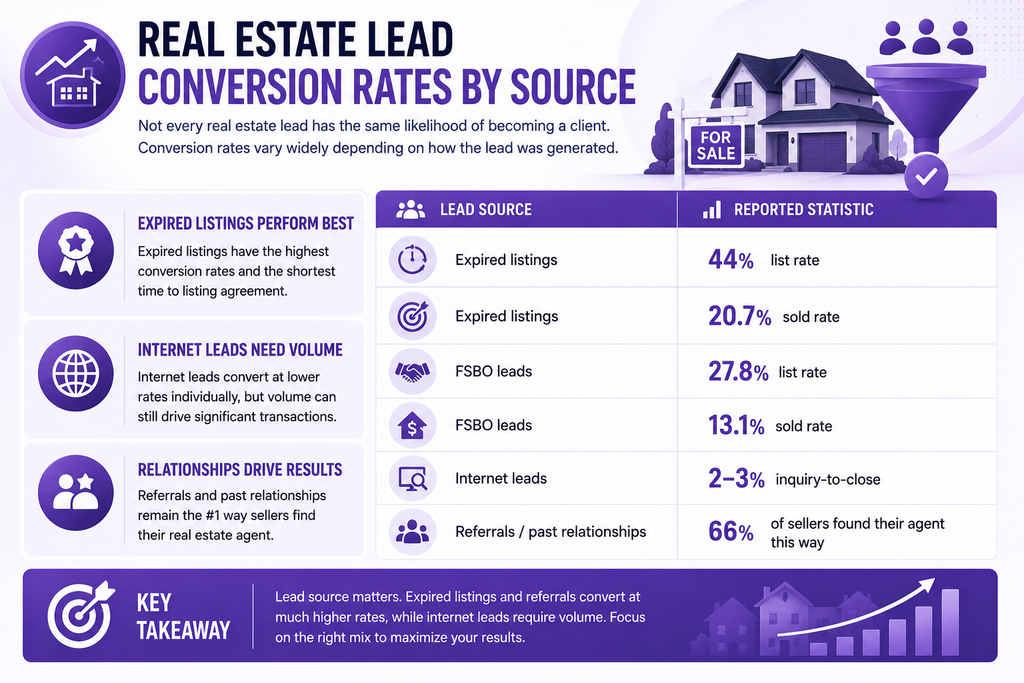
Internet leads have a much lower individual conversion rate. Multiple sources put internet lead conversion at approximately 2–3% from inquiry to closing. However, the sources emphasize that internet lead generation is volume-based, meaning a large pipeline can still produce meaningful numbers of transactions.
Referrals remain particularly important. 66% of sellers found their agent through a referral or past relationship, making existing relationships one of the strongest sources of seller opportunities.
Sources: (REDX, Deal Machine OS, CloseDaily)
Real Estate Lead Cost Statistics
The cost of generating a real estate lead varies considerably depending on the marketing channel. One source reports channel-specific costs ranging from roughly $5 to more than $150 per lead, while another gives an average real estate lead cost of $30 – $53.
| Lead generation channel | Reported cost per lead |
| SEO / organic | $14 |
| Facebook Ads | $5 – $25 |
| Instagram Ads | $15 – $40 |
| Google Search Ads | $42 – $66 |
| Zillow Premier Agent | $20 – $150 |
| REDX expired data | $1 – $3 per record |
| Mature content marketing | $7 – $15 |
Google Search Ads have a higher reported cost than Facebook Ads, but the sources also report a 4–8% conversion rate for Google leads compared with 1–3% for Facebook Ads.
One source reports a blended industry average cost per lead of $448, while another reports the average real estate lead at 30-53. These figures measure different benchmarks and should not be treated as interchangeable. The available data instead demonstrates how dramatically lead costs can differ depending on the channel and methodology.
Sources: (LeadResponse, Deal Machine OS, First Page Sage)
Speed-to-Lead Statistics
Response time is one of the clearest recurring themes across all four sources. The statistics consistently show that contacting a prospect quickly can have a major effect on qualification and conversion.
78% of buyers work with the first agent who responds, according to the NAR statistic cited by multiple sources. Another widely cited finding reports that leads contacted within five minutes are 21 times more likely to be qualified than leads contacted after 30 minutes.
The contrast with actual agent behavior is substantial. The average real estate agent reportedly takes 917 minutes, or more than 15 hours, to respond to a new lead.
There are also statistics for even faster response times. One source reports that responding within one minute produces a 26% conversion-to-appointment rate, while another reports that contacting a lead within five minutes increases conversion by up to 400% compared with waiting 30 minutes.
The data therefore points to a narrow window immediately after an inquiry when lead engagement is particularly important.
Sources: (Deal Machine OS, AgentZap, LeadResponse)
Real Estate Lead Follow-Up Statistics
Generating a lead is only the beginning. The sources also show that many prospects require multiple contacts before they become clients.
Research cited in the sources indicates that 80% of sales require five or more follow-up contacts. At the same time, 44% of agents give up after just one follow-up, creating a gap between the persistence associated with sales and the behavior of many agents.
Repeated contact can also improve engagement. Leads contacted six or more times reportedly convert at rates 70% higher than leads receiving fewer contact attempts.
Cold calling follows a similar pattern. The sources report that it takes an average of eight cold-call attempts to reach a prospect, while calling a lead six times can increase contact rates by 70%.
For email nurturing, automated campaigns are reported to increase lead conversion by 30%. Another source reports that email marketing converts 40% better than social media for lead generation. These findings also highlight the role of inbound marketing in attracting and nurturing prospects over time.
Together, these figures suggest that lead generation performance is not determined solely by how many prospects enter the pipeline. What happens after the initial inquiry also matters.
Sources: (AgentZap, CloseDaily)
Online Search and Digital Real Estate Lead Statistics
The majority of today’s real estate buyer journey includes online research.
One source reports that 90% of buyers use online resources during their home search, while another statistic-based article puts the figure at 96% of homebuyers using online tools. As search behavior continues to evolve, voice search is another area marketers are tracking. These figures come from different source datasets, but both indicate that digital channels play a central role in the home search.
Buyers also spend considerable time researching before making a decision. The median buyer searched for 10 weeks, while another source reports an average online search duration of 4.7 months.
The sources also report that buyers visit an average of 4.3 real estate websites before contacting an agent. This means prospects may interact with several websites, listings, and digital channels before submitting an inquiry.
Yet agents remain highly influential in the process. 88% of buyers purchased through an agent or broker, and 85% rated their agent as the most useful information source.
Sources: (AgentZap, Deal Machine OS)
Social Media and Video Lead Generation Statistics
Social media and video are significant sources of real estate exposure and lead generation. The statistics from the sources show strong reported performance across both organic and paid social channels:
- 82% of real estate businesses use social media for marketing.
- 60% of agents say social media delivers their highest ROI.
- 39% of agents identify social media as their #1 lead-generating technology, followed by CRM at 23% and local MLS at 17%.
- Real estate social media advertising delivers a reported 520% ROAS.
- Listings featuring video receive 403% more inquiries than listings without video.
- Agents who use video in their marketing generate 66% more qualified leads per year.
- Instagram posts with hashtags receive 12.6% more engagement than posts without them.
Taken together, these statistics highlight the potential of social media and video as channels for generating real estate leads. However, generating more inquiries also makes fast and consistent follow-up important, particularly when prospects reach out through social platforms.
Sources: (Deal Machine OS, LeadResponse, CloseDaily)
Seller and Referral Lead Generation Statistics
Seller leads remain an important part of real estate lead generation, with the available statistics highlighting the importance of agents, referrals, reputation, and high-intent seller opportunities:
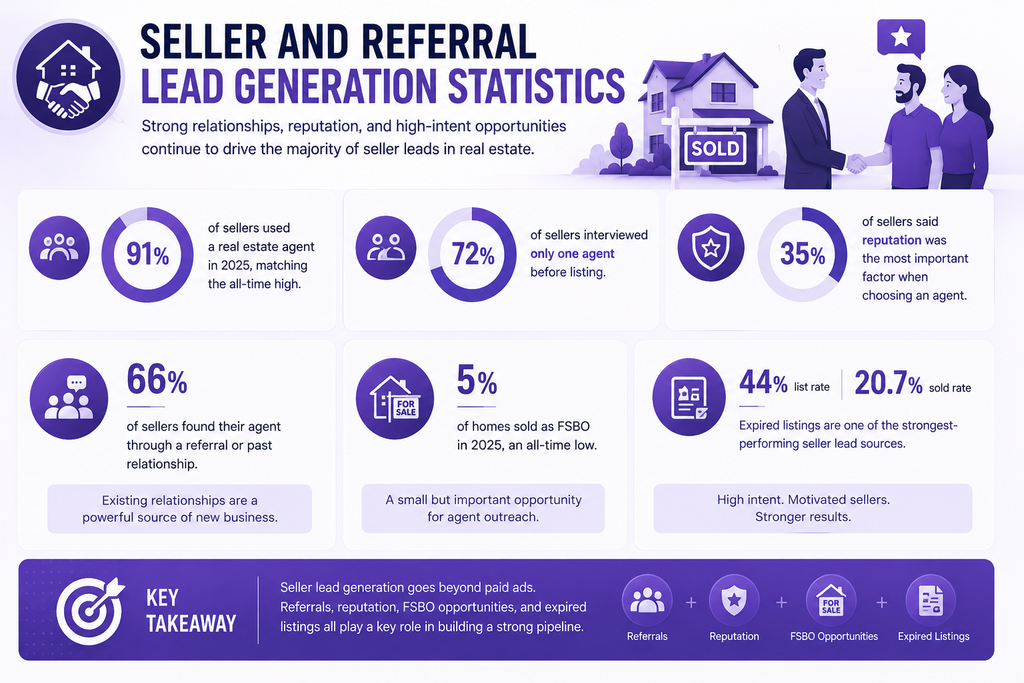
- 91% of sellers used a real estate agent in 2025, matching the reported all-time high.
- 72% of sellers interviewed only one agent before listing.
- 35% of sellers said reputation was the most important factor when choosing an agent.
- 66% of sellers found their agent through a referral or past relationship, making existing relationships an important source of new business.
- Only 5% of homes sold as FSBO in 2025, an all-time low according to a research.
- Expired listings had a reported 44% list rate and 20.7% sold rate, making them one of the strongest-performing seller lead sources in the data.
These figures show that seller lead generation isn’t limited to paid advertising. Referrals, reputation, FSBO opportunities, and expired listings can all play an important role in building a seller pipeline.
Sources: (Deal Machine OS)
Real Estate Marketing, Technology, and Automation Statistics
Marketing investment and technology adoption vary considerably among real estate professionals. The available statistics highlight the growing role of digital marketing, AI, CRM systems, and automation:
| Statistic | Figure |
| Median annual marketing expense | $8,010 |
| Realtors spending less than $1,000/month on marketing | 63.7% |
| Realtors using digital marketing | 89% |
| Real estate agents using AI tools | 82% |
| Reported sales increase associated with CRM adoption | 29% |
| Reported conversion lift among consistent CRM users | 29–41% |
| Reported improvement in lead capture from AI-assisted response systems | 40% |
| Reported ROI from combining SEO and paid advertising | 3.1× |
Although 82% of agents report using AI tools, the sources note that many primarily use AI for basic tasks rather than lead generation, follow-up automation, or predictive analytics. This suggests that adoption is widespread, but how agents apply these technologies can vary significantly.
Sources: (Deal Machine OS, AgentZap)
Conclusion
The available real estate lead generation statistics for 2026 show how much the lead generation process has changed. Buyers increasingly begin their search online, while agents are using social media, video, paid advertising, SEO, CRM systems, and automation to attract and manage prospects.
The data also shows that generating a lead is only part of the process. Lead source, acquisition cost, response time, and follow-up all influence how efficiently opportunities move through the pipeline. For real estate professionals, these statistics provide useful benchmarks for evaluating where leads come from, how much they cost, and how effectively those opportunities are converted.
Sources Used:
- https://www.dealmachineos.com/real-estate-lead-generation-statistics-2026
- https://firstpagesage.com/reports/average-cost-per-lead-by-industry/
- https://www.redx.com/blog/expired-vs-fsbo-listings-what-2-7-million-leads-taught-us-about-conversion/
- https://agentzap.ai/blog/real-estate-lead-statistics
- https://leadresponse.co/blog/real-estate-lead-generation-statistics
- https://closedaily.com/real-estate-lead-generation-statistics-2026/