
AI chatbots have become an increasingly common part of how businesses communicate with customers. What started as simple website chat boxes has developed into a broader range of tools that can answer questions, provide support, qualify leads, assist with sales, and handle routine tasks.
As businesses look for ways to respond faster while managing operating costs, chatbot technology is becoming part of customer service, marketing, sales, and other business functions. At the same time, consumers are becoming more familiar with AI-powered conversations and increasingly expect businesses to provide convenient digital support.
The following AI chatbot statistics provide a closer look at how quickly the technology is growing, where businesses are using it, how consumers respond to it, and what its future could look like.
AI Chatbot Market Statistics
The chatbot industry has experienced substantial growth in recent years, driven by increased business investment in automation, customer experience, and artificial intelligence.
| Statistic | Figure |
| Global chatbot market in 2024 | $7.76 billion |
| Global chatbot market in 2025 | $9.56 billion |
| Global chatbot market in 2026 | $11.8 billion |
| Projected market by 2033 | $41.2 billion |
| Projected CAGR from 2026–2033 | 19.6% |
| North America’s chatbot market share in 2025 | 31.27% |
| Customer service share of the chatbot market | 31.33% |
Industry market research projects the global chatbot market to grow from approximately $9.6 billion in 2025 to more than $41 billion by 2033. The same research estimates a 19.6% compound annual growth rate during that period.
Customer service represents the largest application segment, accounting for 31.33% of the chatbot market. North America also remains the leading regional market, with a 31.27% share reported for 2025.
The broader conversational AI market is growing as well. Research cited in the available industry data estimates that the market could increase from $11.58 billion in 2024 to $41.39 billion by 2030.
Sources: (SlickText, Master of Code, Brilo AI)
Adoption AI Chatbot Statistics
Businesses are increasingly incorporating AI and conversational tools into their operations. Adoption is particularly noticeable in customer service, sales, marketing, and internal business processes.
Some of the key adoption findings include:
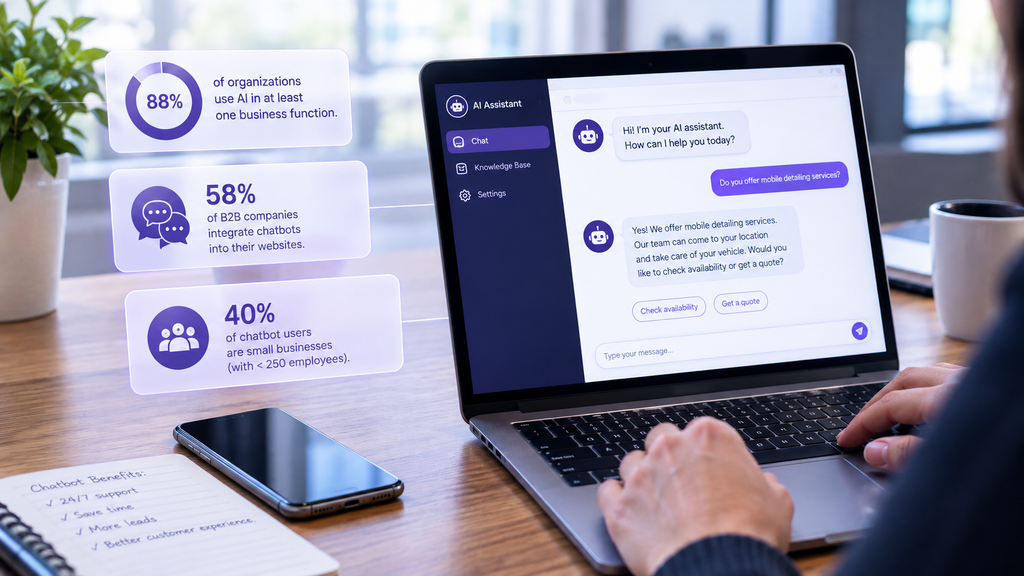
- 88% of organizations reported using AI in at least one business function in a 2025 industry study.
- 62% of organizations were at least experimenting with AI agents capable of acting autonomously.
- 78% of companies in another study had implemented conversational AI in at least one core function.
- 58% of B2B companies were reported to integrate chatbots into their websites, compared with 42% of B2C companies.
- More than 300,000 chatbots are active on Facebook Messenger.
- Around 40% of businesses using chatbots are small companies with fewer than 250 employees.
Adoption is not limited to large enterprises. Smaller businesses are also using chatbots to automate repetitive communication and provide assistance without requiring employees to respond to every basic inquiry manually.
However, adoption does not mean every business is ready to deploy the technology. Research has identified several barriers, including a lack of suitable use cases, security and privacy concerns, and implementation costs.
Sources: (Brilo AI, Master of Code)
How Businesses Use AI Chatbots
Chatbots are being used across multiple departments rather than serving only as customer support tools.
Customer service
Customer service remains one of the most common applications. Businesses use chatbots to answer frequently asked questions, provide information, handle routine requests, and direct more complicated issues to human representatives.
One industry study found that chatbots can handle up to 80% of routine questions, potentially reducing the amount of repetitive work handled by customer service teams.
Another study found that 64% of agents equipped with AI chatbots could dedicate their time to solving complex problems, compared with 50% of agents without chatbot assistance.
Chatbots can also improve response speed. Research has found that they can respond approximately three times faster than humans, making them particularly useful when customers expect immediate answers. Sources: (SlickText, Sixth City Marketing)
Sales and marketing
Chatbots are also being used to generate and qualify leads, recommend products, answer pre-sales questions, and assist customers through the buying process.
Sales is one of the most common business applications, accounting for 41% of chatbot use in one industry study. Marketing follows at 17%, while customer service and client support represent another major area of adoption. Lead generation is another important application. One study found that 36% of businesses implement chatbots specifically to improve their lead generation strategies.
Businesses are also reporting measurable sales benefits. Research cited in the available statistics found that chatbot technology has been associated with a 67% increase in sales, while 35% of business leaders said chatbots helped them close a sales deal. Because chatbots can interact with website visitors immediately, they can also help businesses capture potential customers who might otherwise leave without contacting the company.
Chatbots can also support customers during the research and buying process by answering questions, providing product information, and guiding visitors toward relevant products or services. In the automotive industry, 67% of the automotive buyers expect virtual car tours, showing how interactive digital experiences are becoming part of the purchasing journey.
Sources: (Master of Code)
Customer Service AI Chatbot Statistics
Customer service is one of the strongest use cases for chatbot technology because many support requests are repetitive and relatively straightforward.
| Customer service finding | Statistic |
| Routine questions chatbots can answer | Up to 79% |
| Contact-center tasks chatbots can potentially complete | 30% |
| Live chat communications chatbots can manage | 30% |
| Businesses reporting faster complaint resolution | 90% |
| Potential U.S. savings from automating contact-center tasks | $23 billion |
| Consumers expecting websites to offer chatbots | 73% |
Businesses can potentially reduce support costs by approximately 30% by using chatbots for repetitive customer service tasks. Industry estimates have also placed the potential U.S. savings from automating a portion of contact-center work at $23 billion.
The technology is particularly valuable outside traditional business hours. Consumers increasingly expect businesses to be available when they need assistance, and chatbot availability can help fill that gap without requiring a customer service team to operate around the clock.
At the same time, chatbots are not necessarily a replacement for human representatives. More complex problems still require human judgment, and businesses need clear escalation processes when an automated system cannot appropriately resolve an issue.
Sources: (SlickText, Sixth City Marketing, Master of Code)
Consumer Usage Chatbot Statistics
Consumers are becoming increasingly familiar with chatbot technology. Many people have already interacted with a chatbot, whether through customer service, messaging platforms, ecommerce websites, or AI assistants.
Research compiled across the provided studies found:
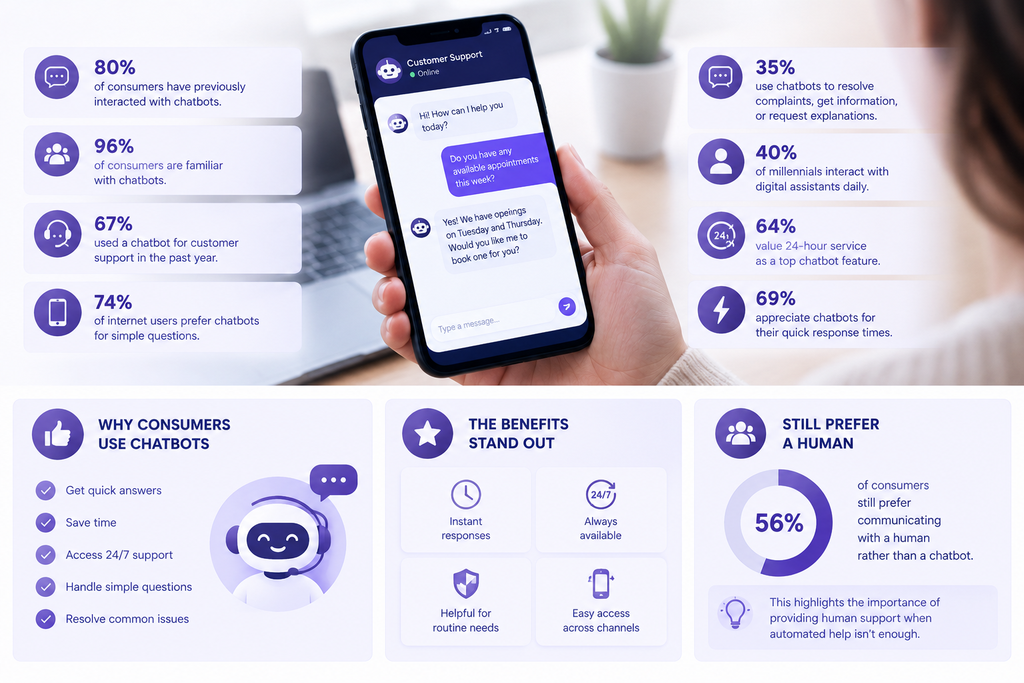
- 80% of consumers have previously interacted with chatbots.
- 96% of consumers are familiar with chatbots.
- 67% of customers reported using a chatbot for customer support within the previous year.
- 74% of internet users prefer using chatbots for simple questions.
- 35% of people use chatbots to resolve complaints, obtain information, or get explanations.
- 40% of millennials interact with digital assistants daily.
- 64% of internet users consider 24-hour service one of the best features of chatbots.
- 69% of consumers appreciate chatbots for their quick response times.
Convenience is one of the main reasons consumers use these tools. Quick responses and 24-hour availability make chatbots particularly useful for straightforward questions and routine customer service needs.
However, consumer attitudes are not uniformly positive. 56% of consumers still prefer communicating with a human rather than a chatbot, highlighting the importance of giving customers access to human assistance when automated support is not enough.
Sources: (Sixth City Marketing, Invesp, Master of Code, Outgrow, Business Insider)
AI Chatbot Statistics for Lead Generation
Lead generation is another area where chatbots can provide value. Rather than relying exclusively on contact forms, businesses can use conversational tools to interact with visitors while they are actively browsing a website.
A chatbot can ask qualifying questions, collect contact information, identify the visitor’s needs, recommend an appropriate service, or transfer the conversation to a salesperson.
Research shows that 36% of businesses use chatbots to improve their lead generation efforts. Another finding indicates that 55% of companies using digital assistants experience an increase in high-quality leads.
Chatbots can also influence conversions by engaging visitors who might otherwise leave without taking action. One study found that businesses using AI chatbots can achieve conversion rates three times higher than businesses relying only on traditional website forms.
The effectiveness of a chatbot depends heavily on how it is implemented. A poorly designed bot that gives irrelevant answers can create friction instead of improving the customer experience.
Sources: (Sixth City Marketing, Master of Code)
Chatbot ROI and Business Benefits
The appeal of chatbots goes beyond customer convenience. Businesses are adopting the technology because it can help reduce operating costs, automate repetitive work, and improve productivity.
| Business benefit | Finding |
| Potential reduction in customer support costs | Up to 30% |
| Potential automation of contact-center tasks | 30% |
| Increase in reported sales | 67% |
| Businesses reporting better ROI with chatbots | 57% |
| Businesses reporting faster complaint resolution | 90% |
| Routine question answers chatbots can handle | Up to 80% |
Automating repetitive questions allows employees to spend more time on complex customer problems, sales conversations, and other work that requires human judgment. This can also help teams manage higher volumes of inquiries without increasing their workload at the same rate.
Beyond customer-facing tasks, chatbots can support internal productivity. 61% of respondents in one study believed chatbots could increase productivity by automating task follow-ups, while 57% believed they could improve communication within their organization.
The financial impact will vary depending on the business, the number of interactions being automated, and how the chatbot is implemented. In general, chatbots are most useful for high-volume, repetitive tasks where automation can save employees time without compromising the customer experience.
Sources: (SlickText, Sixth City Marketing, Outgrow, Master of Code)
Chatbot Statistics by Industry
Chatbot adoption varies across industries, with businesses using the technology for different purposes depending on their customers, workflows, and service requirements.
| Industry | Notable chatbot statistics |
| Real estate | 28% of businesses use chatbots |
| Healthcare | Market projected to reach $431.47 million by 2028 |
| Finance & banking | More than 98 million U.S. users interacted with a bank bot in 2022 |
| Automotive | More than 90% of North American dealerships have chat support |
| Travel | 25% of travel and hospitality companies use digital assistants |
| Retail & ecommerce | 30.34% share of the chatbot market in one industry study |
These figures show that chatbot adoption is not limited to a single type of business. Customer service, reservations, sales inquiries, administrative tasks, and product-related questions are among the areas where conversational technology can be particularly useful.
The specific role of a chatbot can also vary significantly between industries. A healthcare organization may use one to assist with administrative requests, while an automotive business may use it to answer vehicle questions or help customers schedule service. Financial institutions can use conversational tools to handle routine banking inquiries, while retailers can use them to assist shoppers throughout the purchasing process.
This industry-specific approach is important because the value of a chatbot depends less on simply having one and more on how well it addresses the needs of the customers and business using it.
Sources: (Sixth City Marketing, Master of Code)
AI Chatbot and Voice Assistant Statistics
The chatbot market is also expanding beyond typed conversations. Voice-enabled AI is becoming an increasingly important part of how customers interact with businesses.
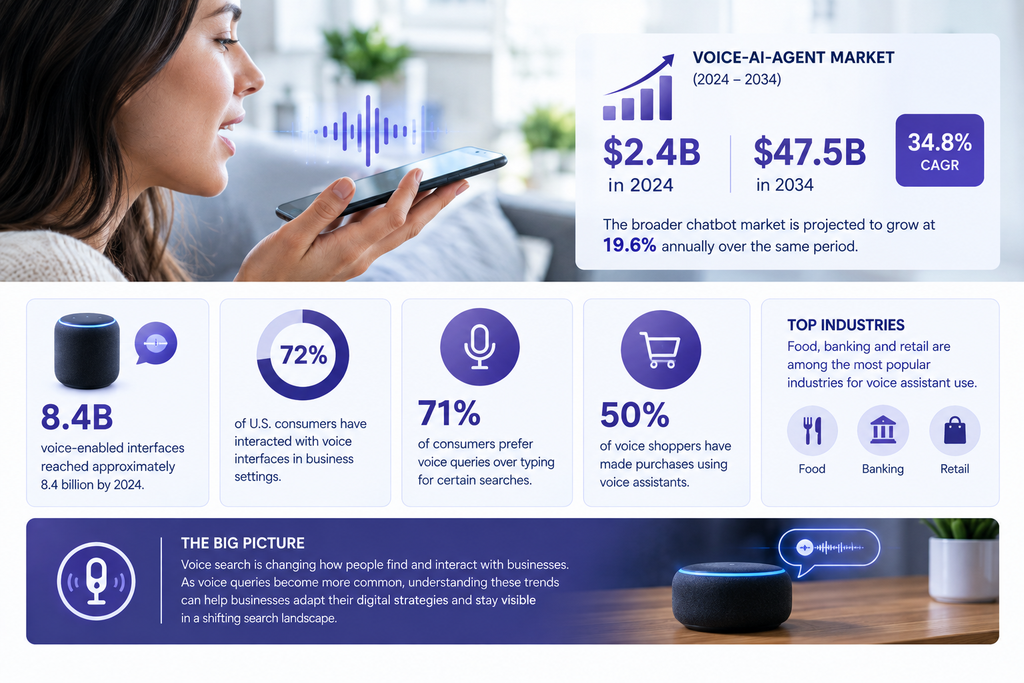
Industry data indicates that the voice-AI-agent market could grow from $2.4 billion in 2024 to $47.5 billion by 2034, representing a 34.8% compound annual growth rate. For comparison, the broader chatbot market is projected to grow at 19.6% annually over its corresponding forecast period.
Other voice-related findings include:
- Voice-enabled interfaces reached approximately 8.4 billion by 2024.
- 72% of U.S. consumers have interacted with voice interfaces in business settings.
- 71% of consumers prefer voice queries over typing for certain searches.
- 50% of voice shoppers have made purchases using voice assistants.
- Food, banking, and retail are among the most popular industries for voice assistant use.
These trends are also relevant to the broader shift in how people search for and interact with businesses. As voice queries become more common, understanding the latest voice search statistics can help businesses adapt their digital strategies to changing search behavior.
The shift toward voice AI is particularly significant for businesses that depend on phone calls. Text chatbots can handle website conversations, while voice AI can interact with customers over the phone, creating another opportunity to automate routine inquiries, qualify callers, schedule appointments, and route more complex requests to a human representative.
Sources: (Brilo AI, Master of Code)
Frequently Asked Questions About AI Chatbots
How many businesses use AI chatbots?
Chatbot adoption varies depending on how the technology is defined and which businesses are included in a study. One recent study found that 78% of companies had implemented conversational AI in at least one core business function, while other research has reported lower adoption rates among specific business groups.
What are businesses using chatbots for?
The most common applications include customer service, sales, marketing, lead generation, answering frequently asked questions, and automating repetitive tasks. Sales accounted for 41% of business chatbot applications in one study, with marketing accounting for 17%.
Do consumers prefer chatbots over human customer service?
Consumer preferences are mixed. Many customers appreciate the speed and availability of chatbots, particularly for simple questions. However, research also shows that a significant share of consumers still prefer human assistance, especially when dealing with more complicated problems.
Can AI chatbots generate leads?
Yes. Chatbots can qualify visitors, collect contact information, answer pre-sales questions, and direct prospects toward a conversion. One study found that 36% of businesses use chatbots to improve lead generation, while another reported that 55% of companies using digital assistants experienced an increase in high-quality leads.
Can chatbots reduce customer service costs?
They can. Industry research estimates that businesses can reduce customer support costs by up to 30% by automating repetitive tasks and inquiries. The actual savings depend on the volume and type of customer interactions a business receives.
Are voice chatbots growing faster than text chatbots?
Current industry projections indicate that voice AI is growing faster. The voice-AI-agent market has been projected to expand at a 34.8% CAGR, compared with 19.6% for the broader chatbot market.
Conclusion
AI chatbots are becoming a practical tool for businesses looking to improve customer service, automate repetitive tasks, and support lead generation. As conversational AI expands into voice and more advanced systems, businesses have more ways to use automation across the customer journey.
The best approach is not to automate everything, but to use AI where it improves the customer experience while keeping human support available when it matters.
Sources Used:
- https://www.slicktext.com/blog/2020/04/chatbot-statistics/
- https://www.brilo.ai/resources/ai-chatbot-statistics
- https://www.sixthcitymarketing.com/chatbot-statistics/
- https://www.businessinsider.com/chatbots-are-gaining-traction-2017-5
- https://www.invespcro.com/blog/chatbots-customer-service/
- https://masterofcode.com/blog/chatbot-statistics
- https://outgrow.co/blog/vital-chatbot-statistics
- https://www.chatbot.com/blog/chatbot-statistics/